Quotessence
Home / Quotes / Quote by Jiddu Krishnamurti

Quote by Jiddu Krishnamurti

“How do you listen? Do you listen with your projections, through your projection, through your ambitions, desires, fears, anxieties, through hearing only what you want to hear, only what will be satisfactory, what will gratify, what will give comfort, what will for the moment alleviate your suffering? If you listen through the screen of your desires, then you obviously listen to your own voice; you are listening to your own desires. And is there any other form of listening? Is it not important to find out how to listen not only to what is being said but to everything – to the noise in the streets, to the chatter of birds, to the noise of the tramcar, to the restless sea, to the voice of your husband, to your wife, to your friends, to the cry of a baby? Listening has importance only when on is not projecting one’s own desires through which one listens. Can one put aside all these screens through which we listen, and really listen?”

Quote by Jiddu Krishnamurti

Work

The Book of Life

This book delves into the concept of the afterlife, examining the diverse beliefs and cultural perspectives from around the world. It investigates the stories, rituals, and traditions that have shaped human understanding of life beyond death, offering a rich tapestry of insights into the mysteries of existence after physical death. more

Author
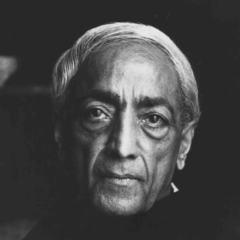
Jiddu Krishnamurti
Jiddu Krishnamurti

Jiddu Krishnamurti was an Indian philosopher, speaker, and writer who lived from May 12, 1895, to February 17, 1986. He is known for his teachings on the nature of the mind, consciousness, and the path to enlightenment. Krishnamurti emphasized the importance of self-inquiry and the transformation of consciousness, and his work has had a significant impact on individuals from various walks of life. more

You May Also Like

“One day we took the children to see a goldsmith refine gold after the ancient manner of the East. He was sitting beside his little charcoal fire. ("He shall sit as a refiner"; the gold- or silversmith never leaves his crucible once it is on the fire.) In the red glow lay a common curved roof tile; another tile covered it like a lid. This was the crucible. In it was the medicine made of salt, tamarind fruit and burnt brick dust, and imbedded in it was the gold. The medicine does its appointed work on the gold, "then the fire eats it," and the goldsmith lifts the gold out with a pair of tongs, lets it cool, rubs it between his fingers, and if not satisfied puts it back again in fresh medicine. This time he blows the fire hotter than it was before, and each time he puts the gold into the crucible, the heat of the fire is increased; "it could not bear it so hot at first, but it can bear it now; what would have destroyed it then helps it now." "How do you know when the gold is purified?" we asked him, and he answered, "When I can see my face in it [the liquid gold in the crucible] then it is pure.”

“All striving comes from lack, from a dissatisfaction with one's condition, and is thus suffering as long as it is not satisfied; but no satisfaction is lasting; instead, it is only the beginning of a new striving. We see striving everywhere inhibited in many ways, struggling everywhere; and thus always suffering; there is no final goal of striving, and therefore no bounds or end to suffering.”

“There is no ongoing spiritual life without this process of letting go. At the precise point where we refuse, growth stops. If we hold tightly to anything given to us, unwilling to let it go when the time comes to let it go or unwilling to allow it to be used as the Giver means it to be used, we stunt the growth of the soul. It is easy to make a mistake here, “If God gave it to me,” we say, “its mine. I can do what I want with it.” No. The truth is that it is ours to thank Him for and ours to offer back to Him, ours to relinquish, ours to lose, ours to let go of – if we want to find our true selves, if we want real life, if our hearts are set on glory.”