Quotessence
Home / Quotes / Quote by James Madison

Quote by James Madison

Work

The Federalist: On the New Constitution, Written in 1788

Comprising a series of 85 essays, this seminal work discusses the structure and principles of the new American government established by the Constitution of the United States, originally published in 1788. more

Author
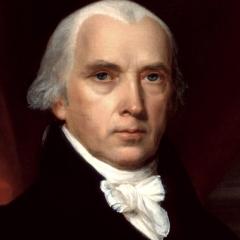
James Madison
James Madison

James Madison, the 4th President of the United States, was born on March 16, 1751, and died on June 28, 1836. He was a key figure in drafting the U.S. Constitution and had a profound impact on the political system of the United States. more

You May Also Like

“The first question that offers itself is, whether the general form and aspect of the government be strictly republican? It is evident that no other form would be reconcileable with the genius of the people of America; with the fundamental principles of the revolution; or with that honourable determination which animates every votary of freedom, to rest all our political experiments on the capacity of mankind for self-government.”

“What is to be the consequence, in case the Congress shall misconstrue this part [the necessary and proper clause] of the Constitution and exercise powers not warranted by its true meaning, I answer the same as if they should misconstrue or enlarge any other power vested in them . . . the success of the usurpation will depend on the executive and judiciary departments, which are to expound and give effect to the legislative acts; and in a last resort a remedy must be obtained from the people, who can by the elections of more faithful representatives, annul the acts of the usurpers.”

“Nothing has yet been offered to invalidate the doctrine that the meaning of the Constitution may as well be ascertained by the Legislative as by the Judicial authority.”

“I acknowledge, in the ordinary course of government, that the exposition of the laws and Constitution devolves upon the judicial. But I beg to know upon what principle it can be contended that any one department draws from the Constitution greater powers than another in marking out the limits of the powers of the several departments.”

“Good constitutions are formed upon a comparison of the liberty of the individual with the strength of government: If the tone of either be too high, the other will be weakened too much. It is the happiest possible mode of conciliating these objects, to institute one branch peculiarly endowed with sensibility, another with knowledge and firmness. Through the opposition and mutual control of these bodies, the government will reach, in its regular operations, the perfect balance between liberty and power.”

“[T]o preserve the republican form and principles of our Constitution and cleave to the salutary distribution of powers which that [the Constitution] has established . . . are the two sheet anchors of our Union. If driven from either, we shall be in danger of foundering.”

“The principle of the Constitution is that of a separation of legislative, Executive and Judiciary functions, except in cases specified. If this principle be not expressed in direct terms, it is clearly the spirit of the Constitution, and it ought to be so commented and acted on by every friend of free government.”