Quotessence
Home / Quotes / Quote by Walt Whitman

Quote by Walt Whitman

“Trippers and askers surround me, People I meet, the effect upon me of my early life or the ward and city I live in, or the nation, The latest dates, discoveries, inventions, societies, authors old and new, My dinner, dress, associates, looks, compliments, dues, The real or fancied indifference of some man or woman I love, The sickness of one of my folks or of myself, or ill-doing or loss or lack of money, or depressions or exaltations, Battles, the horrors of fratricidal war, the fever of doubtful news, the fitful events; These come to me days and nights and go from me again, But they are not the Me myself. Apart from the pulling and hauling stands what I am, Stands amused, complacent, compassionating, idle, unitary, Looks down, is erect, or bends an arm on an impalpable certain rest, Looking with side-curved head curious what will come next, Both in and out of the game and watching and wondering at it. Backward I see in my own days where I sweated through fog with linguists and contenders, I have no mockings or arguments, I witness and wait.”

Quote by Walt Whitman

Work

Song of Myself

Walt Whitman's 'Song of Myself' is a seminal work in American literature, featuring a series of free-verse poems that reflect on the self, society, and the natural world. The work is known for its innovative structure and lyrical expression, celebrating the diversity and complexity of human life. more

Author
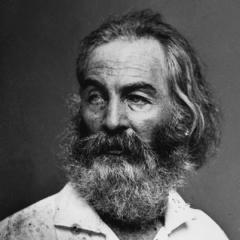
Walt Whitman
Walt Whitman

American poet, considered one of the pioneers of American poetry. His work, 'Leaves of Grass,' has had a profound impact on American poetry. more

You May Also Like

“One of the new things people began to find out in the last century was that thoughts--just mere thoughts--are as powerful as electric batteries--as good for one as sunlight is, or as bad for one as poison. To let a sad thought or a bad one get into your mind is as dangerous as letting a scarlet fever germ get into your body. If you let it stay there after it has got in you may never get over it as long as you live.”

“In my contact with people I find that, as a rule, it is only the little, narrow people who live for themselves, who never read good books, who do not travel, who never open up their souls in a way to permit them to come into contact with other souls -- with the great outside world. No man whose vision is bounded by colour can come into contact with what is highest and best in the world. In meeting men, in many places, I have found that the happiest people are those who do the most for others; the most miserable are those who do the least. I have also found that few things, if any, are capable of making one so blind and narrow as race prejudice. I often say to our students, in the course of my talks to them on Sunday evenings in the chapel, that the longer I live and the more experience I have of the world, the more I am convinced that, after all, the one thing that is most worth living for -- and dying for, if need be -- is the opportunity of making some one else more happy and more useful.”

“If you are not in control of your thoughts then you are not in control of yourself. Without self-control, you have no real power, regardless of whatever else you accomplish. If you are not aware of the thoughts that you are thinking in each moment, then you are the rider with no reins, with no power over where you are going. You cannot control what you are not aware of. Awareness must come first.”

“Pretjerano čitanje ne čini nas pametnijim. Neki ljudi jednostavno 'gutaju' knjige. Oni to čine bez onih neophodnih intervala razmišljanja, koji su potrebni da se pročitano 'svari', preradi, usvoji, razumije. Kod čitanja lični doprinos je potreban kao što je pčeli potreban 'unutrašnji' rad, pa i vrijeme, da sakupljeni cvijetni prah pretvori u med.”

“There are tumults of the mind, when, like the great convulsions of Nature, all seems anarchy and returning chaos; yet often, in those moments of vast disturbance, as in the strife of Nature itself, some new principle of order, or some new impulse of conduct, develops itself, and controls, and regulates, and brings to an harmonious consequence, passions and elements which seem only to threaten despair and subversion.”