Quotessence
Home / Quotes / Quote by Jeffrey Kluger

Quote by Jeffrey Kluger

“A fishnet is made up of a lot more holes than strings, but you can't therefore argue that the net doesn't exist. Just ask the fish.”

Quote by Jeffrey Kluger

Author
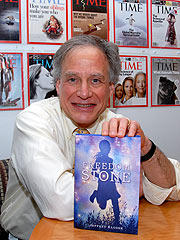
Jeffrey Kluger
Jeffrey Kluger

Jeffrey Kluger is an American writer born in 1954. He is known for his in-depth reporting on science, technology, and cultural phenomena, and has won numerous awards for his work. Kluger has served as an editor and columnist for several prominent media outlets, including Time magazine and Scientific American. His writing style is characterized by clarity, wit, and insight. more

You May Also Like

“Black people in America have to, for their own protection, develop a defense mechanism, and I just grew terribly tired of it. When you sustain that kind of affront, and sustain it and sustain it and sustain it, something happens to you. You try to steer a course in American society that's not self-destructive. But America is a country that inflicts injury. It does not like to see anything that comes in response, and accuses one of anger as if it were an unnatural response. For anyone who is not white in America, the affronts are virtually across the board.”

“Something is very, very wrong with American culture. The signs are everywhere. I think the country is in almost terminal descent. The business class is combined with the evangelicals. And I think the evangelicals want to provoke an immense global disaster to precipitate the second coming of Christ. So they are very happy about what we're doing to Iraq - and the menace we present now for Syria and for Iran - because they think that the apocalypse is an important thing to get into so that they can see vindicated their most literal interpretation of the Bible.”

“The U.S. has the largest prison population in the world: two million people. One out of every eight prisoners in the world is an African American. We are warehousing people as a profit to shareholders or for benefits to communities that get to host federal prisons. It is modern slavery. The whole future of America's black community is at risk. One out of every three young black men in Washington, D.C., is under one arm or the other of the criminal justice system. These are the continuing consequences of slavery.”

“I write in the studio, I don't sit around with a piano or a guitar and write songs. I get satisfaction out of that because I can finish the song really quickly. I can use whatever momentum I have. I've got to put it down, develop it, and get it as far [as I can], because the excitement of the moment of when you get that idea - you want to try and hold it and build on it and really gain strength from it. Being in the studio and writing songs like that is really the best way.”

“Because I was a chemistry student and was never supposed to be a musician, I always felt like I was an outsider looking at music going "Why is this interesting to me? Why should I be doing this?" and I never felt like I was a natural musician. It came into my life, kind of, as a conceptual problem and I think all my pieces are, in a way, looking at some issue and sometimes veering toward an inside baseball model of classical music.”

“I think, when you're a young composer, you're told constantly that what you're supposed to do is figure out what your voice is. "What is your thing supposed to sound like?" You know: "What's the thing you do," that everyone can recognizably tell from a long distance is you and then you're supposed to be in search of that marker and you're supposed to find it and you're supposed to live there for the rest of your life. And it seemed to me, from a young age, that was what I was encouraged to do. You find a sound and that's your sound! That's what you do.”

“Normally classical music is set up so you have professionals on a stage and a bunch of audience - it's us versus them. You spend your entire time as an audience member looking at the back of the conductor so you're already aware of a certain kind of hierarchy when you are there: there are people who can do it, who are on stage, and you aren't on stage so you can't do it. There's also a conductor who is telling the people who are onstage exactly what to do and when to do it and so you know that person is more important than the people on stage.”

“I think it's important to remember that an artist could be at the center of healing our problems because, every day, that's what we do. Every day, our job is to make something that wasn't there before. We're kind of built to go into situations that need a kind of fresh thought to solve them so I'm happy about that and I would encourage anyone with any problem in the world that needs to be solved to consider having any person in the creative arts be at the core of its solution. I think that's one of our unused or untapped values.”

“Having music in the schools, having art in the schools, having art in your life, should not be heroic. It should be every day. Having things we've paid for years ago and that we depend on kept up - our schools, our political institutions - should not be a heroic act. It should be part of our daily citizenship. The idea that we had to do this incredibly exhausting, two-year-long, very expensive, labor intensive, community-based action, is, one the one hand unbelievably great, and, on the other hand, really depressing.”