Quotessence
Home / Quotes / Quote by Swami Vivekananda

Quote by Swami Vivekananda

“At the head of all these laws, in and through every particle of matter and force, stands One through whose command the wind blows, the fire burns, the clouds rain, and death stalks upon the earth. And what is His nature? He is everywhere the pure and formless One, the Almighty and the All Merciful. Thou art our Father. Thou art our beloved Friend.”

Quote by Swami Vivekananda

Work

Vivekananda Reader

This book compiles a selection of lectures and essays by Swami Vivekananda, a prominent Indian spiritual leader and philosopher. It offers insights into his thoughts on various aspects of life, spirituality, and the nature of existence, drawing from his experiences and teachings. more

Author

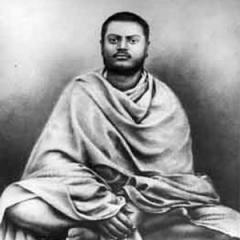
Swami Vivekananda
Swami Vivekananda

Swami Vivekananda (January 12, 1863 – July 4, 1902) was an Indian Hindu monk, philosopher, and social reformer. Born as Narendranath Datta in Kolkata, he was a chief disciple of the mystic Ramakrishna. He is best known for his historic speech at the 1893 Parliament of the World's Religions in Chicago, where he introduced Hinduism to the Western world. He founded the Ramakrishna Mission in 1897, focusing on social service, education, and interfaith harmony. His teachings emphasized self-realization, service to humanity, and the unity of all religions. He wrote extensively on yoga and Vedanta philosophy, influencing global spirituality and Indian nationalism. He died at the age of 39, leaving a lasting legacy as a bridge between Eastern and Western thought. more
You May Also Like

“He is everywhere, the pure and formless One, the Almighty and the All-merciful. "Thou art our father, Thou art our mother, Thou art our beloved friend, Thou art the source of all strength; give us strength. Thou art He that beareth the burdens of the universe; help me bear the little burden of this life." Thus sang the Rishis of the Vedas. And how to worship Him? Through love. "He is to be worshipped as the one beloved, dearer than everything in this and the next life."”

“Only love for the Supreme Lord is true Bhakti. Love for any other being, however great, is not Bhakti. The "Supreme Lord" here means Ishvara, the concept of which transcends what you in the West mean by the personal God. "He from whom this universe proceeds, in whom it rests, and to whom it returns, He is Ishvara, the Eternal, the Pure, the All-Merciful, the Almighty, the Ever-Free, the All-Knowing, the Teacher of all teachers, the Lord who of His own nature is inexpressible Love."”

“The first angle is, love questions not. It is not a beggar. ... When love asks nothing, [when it] gives everything. This is the real spiritual worship, the worship through love. Whether God is merciful is no longer questioned. He is God; He is my love. Whether God is omnipotent and almighty, limited or unlimited , is no longer questioned.”

“There cannot be two almighty beings in this world. [Imagine having] two or three Gods; one will create the world, another says, "I will destroy the world." It [can] never happen. There must be one God. The soul attains to perfection; [it becomes] almost omnipotent [and] omniscient. This is the worshipper. Who is the worshipped? He, the Lord God Himself, the Omnipresent, the Omniscient, and so on. And above all, He is Love. How is [the soul] to attain this perfection? By worship.”