Quotessence
Home / Quotes / Quote by Denis Diderot

Quote by Denis Diderot

“We are a free people; and now you have planted in our country the title deeds of our future slavery. You are neither god nor demon; who are you, then, to make slaves? Orou! You understand the language of these men, tell us all, as you have told me, what they have written on this sheet of metal: This country is ours. This country yours? And why? Because you have walked thereon? If a Tahitian landed one day on your shores, and scratched on one of your rocks or on the bark of your trees: This country belongs to the people of Tahiti - what would you think?”

Quote by Denis Diderot

Author
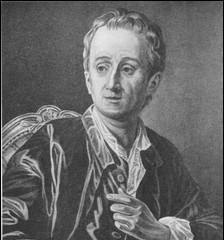
Denis Diderot
Denis Diderot

Denis Diderot was a French philosopher, art critic, and writer who played a pivotal role in the Enlightenment. He is best known for his work on the Encyclopédie, which aimed to compile all the knowledge of the time into a single work. more

You May Also Like

“However we select from nature a complex [of phenomena] using the criterion of simplicity, in no case will its theoretical treatment turn out to be forever appropriate (sufficient).... I do not doubt that the day will come when [general relativity], too, will have to yield to another one, for reasons which at present we do not yet surmise. I believe that this process of deepening theory has no limits.”

“The worker who knows the cause of his misery, who understands the make-up of our iniquitous social and industrial system can do more for himself and his kind than Christ and the followers of Christ have ever done for humanity; certainly more than meek patience, ignorance, and submission have done.”

“I was called before the head matron, a tall woman with a stolid face. She began taking my pedigree. What religion? was the first question. None, I am an atheist. Atheism is prohibited here. You will have to go to church. I replied that I would do nothing of the kind. I did not believe in anything the Church stood for and, not being a hypocrite, I would not attend.”

“How to raise this dead level of theistic belief is really a matter of life and death for all denominations. Therefore their tolerance; but it is a tolerance not of understanding; but of weakness.”

“Have not all theists painted their Deity as the god of love and goodness? Yet after thousands of years of such preachments the gods remain deaf to the agony of the human race. Confucius cares not for the poverty, squalor and misery of the people of China. Buddha remains undisturbed in his philosophical indifference to the famine and starvation of outraged Hindoos; Jahve continues deaf to the bitter cry of Israel; while Jesus refuses to rise from the dead against his Christians who are butchering each other.”

“Atheism ... in its philosophic aspect refuses allegiance not merely to a definite concept of God, but it refuses all servitude to the God idea, and opposes the theistic principle as such. Gods in their individual function are not half as pernicious as the principle of theism which represents the belief in a supernatural, or even omnipotent, power to rule the earth and man upon it. It is the absolutism of theism, its pernicious influence upon humanity, its paralyzing effect upon thought and action, which Atheism is fighting with all its power.”