Quotessence
Home / Quotes / Quote by Gilbert K. Chesterton

Quote by Gilbert K. Chesterton

“The truth is, of course, that the curtness of the Ten Commandments is an evidence, not of the gloom and narrowness of a religion, but, on the contrary, of its liberality and humanity. It is shorter to state the things forbidden than the things permitted; precisely because most things are permitted, and only a few things are forbidden.”

Quote by Gilbert K. Chesterton

Author
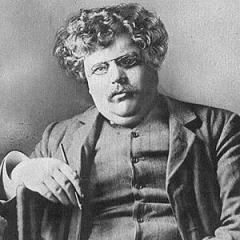
Gilbert K. Chesterton

Gilbert K. Chesterton was an English writer, critic, and theologian, born on May 29, 1874, and died on June 14, 1936. Known for his unique literary style and profound philosophical thinking, Chesterton's works spanned a variety of genres, including novels, poetry, drama, and criticism. more

You May Also Like

“There are two men in each one of us: the scientist, he who starts with a clear field and desires to rise to the knowledge of Nature through observations, experimentation and reasoning, and the man of sentiment, the man of belief, the man who mourns his dead children, and who cannot, alas, prove that he will see them again, but who believes that he will, and lives in the hope – the man who will not die like a vibrio, but who feels that the force that is within him cannot die.”

“We cannot have a world where everyone is a victim. "I'm this way because my father made me this way. I'm this way because my husband made me this way." Yes, we are indeed formed by traumas that happen to us. But you must take charge, you must take over, you are responsible.”

“We must not forget that when radium was discovered no one knew that it would prove useful in hospitals. The work was one of pure science. And this is a proof that scientific work must not be considered from the point of view of the direct usefulness of it. It must be done for itself, for the beauty of science, and then there is always the chance that a scientific discovery may become like the radium a benefit for humanity.”

“To suppose that the eye, with all its inimitable contrivances for adjusting the focus to different distances, for admitting different amounts of light, and for the correction of spherical and chromatic aberration, could have been formed by natural selection, seems, I freely confess, absurd in the highest possible degree.”