Quotessence
Home / Quotes / Quote by Thomas Hobbes

Quote by Thomas Hobbes

Author

Thomas Hobbes
Thomas Hobbes

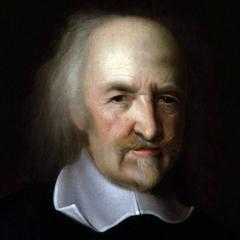
Thomas Hobbes, a British philosopher, politician, historian, economist, and writer, was born on April 5, 1588, in Wiltshire, and died on December 4, 1679, in Oxford, England. Hobbes is considered one of the most important philosophers of the 17th century, known for his profound analysis of the state, society, and human behavior. more

You May Also Like

“Barthes referred to semiology, the science of signs, in pursuing this task. He followed Ferdinand de Saussure’s claim that a sign is merely the outcome of an arbitrary relationship between a signifier (a word, picture, utterance) and a signified (a concept or mental image to which the signifier gives rise) – implying that the words we use have no fixed meanings in themselves. De Saussure called this ability of the sign to represent or convey meaning signification.”

“One way of dying is to make your death alter the state of things in such a way that you no longer have any reason to be a part of it. Thus death can have the effect of a prophetic disappearance. Such were the deaths of Barthes and Lacan, I believe: the world has taken another direction since, in which these subtle figures would no longer have had any meaning. The death of Sartre, by contrast, left the world unchanged and seems an ineluctable, but insignifi cant event. Before dying, he was already to live in a world that was no longer his own. So far as existence is concerned, as Ajar [Romain Gary] would say, it needs to be taken in charge by someone. No one can be expected to bear the responsibility for their own life. This Christian and modern idea is a vain and arrogant proposition. Moreover, it is a groundless utopian notion. The individual would have to be able to transform himself into the vestal, or the slave, of his identity, control all his circuits and all the circuits of the world which meet in his genes, nerves and thoughts. An unprecedented state of servitude. Who would wish to have salvation at such a price? It is so much more human to put one's fate, one's desire, one's will into the hands of another. Circulation of responsibilities, declension of wills, perpetual transfer of forms . Apart from this subtle path, which is attested to by a great many cultures, there is only the totalitarian path of a collective assumption.”

“Barthes announced, “I am not lovingly gazing toward an Oriental essence—to me the Orient is a matter of indifference, merely providing a reserve of features whose manipulation—whose invented interplay— allows me to ‘entertain’ the idea of an unheard-of symbolic system, one altogether detached from our own.” The lesson of Japan for Barthes was “the possibility of difference, of a mutation, of a revolution in the propriety of symbolic systems.” Like Wilde, Barthes does not locate Japaneseness in a place called Japan. But if for Wilde Japaneseness offered a new way of seeing, for Barthes, more complexly, Japan offered a new way of seeing himself being seen, which resulted in a new relationship to language. About himself, Barthes wrote, “The author has never, in any sense, photographed Japan. Rather, he has done the opposite: Japan has starred him with any number of ‘flashes’; or better still, Japan has afforded him a situation of writing.” Japan allowed Barthes to “descend into the untranslatable . . . until everything Occidental in us totters and the rights of the ‘father tongue’ vacillate—that tongue which comes to us from our fathers and which makes us, in our turn, fathers and proprietors of a culture which, precisely, history transforms into ‘nature.’”3 Barthes’s growing sense of the “repressive value” of text as the “level” at which “the morality and ideology of a society are above all invested” animated his delight in a Japanese “situation” that allowed freedoms he associated with images to trump the authority of text in the West.4 Reflecting later on this book about the “system of signs I call Japan,” Barthes emphasized that it “occupied a moment in my life when I felt the necessity of entering completely into the signifier, i.e., of disconnecting myself from the ideological instance as signified, as the risk of the return of the signified, of theology, monologism, of law.”

“The remaining chain swung down, he wrenched the door out and he was free. The last thing he heard behind him was the oncoming stomp of running feet. Now began flight, that excruciating accompaniment to both the sleep-dream and the drug-dream as well. Down endless flights of stairs that seemed to have increased decimally since he had come up them so many days before. Four, fourteen, forty - there seemed no end to them, no bottom. Round and round he went, hand slapping at the worn guard-rail only at the turns to keep from bulleting head-on into the wall each time. The clamor had come out onto a landing high above him now, endless miles above him; a thin voice came shouting down the stair-well, "There he is! See him down there?" raising the hue and cry to the rest of the pack. Footsteps started cannonading down after him, like avenging thunder from on high. They only added wings to his effortless, almost cascading waterlike flight. Like a drunk, he was incapable of hurting himself. At one turning he went off his feet and rippled down the whole succeeding flight of stair-ribs like a wriggling snake. Then he got up again and plunged ahead, without consciousness of pain or smart. The whole staircase-structure seemed to hitch crazily from side to side with the velocity of his descent, but it was really he that was hitching. But behind him the oncoming thunder kept gaining. Then suddenly, after they'd kept on for hours, the stairs suddenly ended, he'd reached bottom at last. He tore out through a square of blackness at the end of the entrance-hall, and the kindly night received him, took him to itself - along with countless other things that stalk and kill and are dangerous if crossed. He had no knowledge of where he was; if he'd ever had, he'd lost it long ago. The drums of pursuit were still beating a rolling tattoo inside the tenement. He chose a direction at random, fled down the deserted street, the wand of light from a wan street-lamp flicking him in passing, so fast did he scurry by beneath it.”