Quotessence
Home / Quotes / Quote by Umberto Boccioni

Quote by Umberto Boccioni

“It isnecessary to destroy the pretended nobility, entirely literaryand traditional, of marble and bronze? The sculptor can use twenty different materials, or even more, in a single work, provided that the plastic emotion requires it.”

Quote by Umberto Boccioni

Author
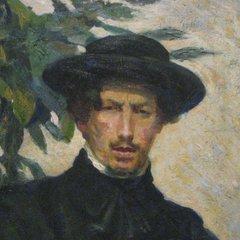
Umberto Boccioni
Umberto Boccioni

Umberto Boccioni (1882-1916) was a pioneering Italian Futurist painter, sculptor, and theorist. Born in Reggio Calabria, he studied in Rome and Paris before co-founding the Futurist movement with Filippo Tommaso Marinetti in 1909. Boccioni's revolutionary works such as "The City Rises" and "Unique Forms of Continuity in Space" transformed traditional artistic representation by emphasizing speed, technology, and dynamic energy. He wrote the influential "Futurist Painting: Technical Manifesto" in 1910. Serving in the Italian army during World War I, he died tragically in a riding accident at age 33 in 1916. His brief but impactful career left an enduring legacy on modern art. more

You May Also Like

“If we paint the phases of a riot, the crowd bustling with uplifted fists and the noisy onslaughts of cavalry are translated upon the canvas in sheaves of lines corresponding with all the conflicting forces, following the general laws of violence of the picture... These force-lines must encircle and involve the spectator so that he will in a manner be forced to struggle himself with the persons in the picture.”

“In the first manifesto that we launched on the 8th of March, 1910, from the stage of the Chiarella Theater in Turin,1 we expressed our deep-rooted disgust with, our proud contempt for, and our happy rebellion against vulgarity, mediocrity, the fanatical and snobbish worship of all that is old, attitudes which are suffocating Art in our Country.”

“Your eyes, accustomed to semi-darkness, will soon open to more radiant visions of light. The shadows which we shall paint shall be more luminous than the high-lights of our predecessors, and our pictures, next to those of the museums, will shine like blinding daylight, compared with deepest night. We conclude that painting cannot exist today without divisionism... ...Divisionism, for the modern painter, must be an innate complementariness which we declare to be essential and necessary.”