Quotessence
Home / Quotes / Quote by Charles Lyell

Quote by Charles Lyell

“So far from having a materialistic tendency, the supposed introduction into the earth at successive geological periods of life,-sensation,-instinct,-the intelligence of the higher mammalia bordering on reason,-and lastly the improvable reason of Man himself, presents us with a picture of the ever-increasing dominion of mind over matter.”

Quote by Charles Lyell

Work

The Geological Evidences of the Antiquity of Man with Remarks on Theories of the Origin of Species by Variation by Charles Lyell

This book delves into the geological record to provide evidence for the long history of human existence, and critically engages with the theories of evolution proposed by Charles Lyell. more

Author
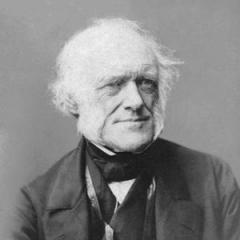
Charles Lyell
Charles Lyell

Charles Lyell, born on November 14, 1797 and died on February 22, 1875, was a renowned lawyer and geologist from the United Kingdom. He is best known for his extensive research in geology and his influential book 'Principles of Geology,' which had a profound impact on the development of the field. more

You May Also Like

“The animal kingdom exhibits a series of mental developments which may be regarded as antecedents to the mental development of man, for the mental life of animals shows itself to be throughout, in its elements and in the general laws governing the combination of the elements, the same as the mental life of man.”

“The first effect of the mind growing cultivated is that processes once multiple get to be performed in a single act. Lazarus has called this the progressive "condensation" of thought. ... Steps really sink from sight. An advanced thinker sees the relations of his topics is such masses and so instantaneously that when he comes to explain to younger minds it is often hard ... Bowditch, who translated and annotated Laplace's Méchanique Céleste, said that whenever his author prefaced a proposition by the words "it is evident," he knew that many hours of hard study lay before him.”

“The human understanding is moved by those things most which strike and enter the mind simultaneously and suddenly, and so fill the imagination; and then it feigns and supposes all other things to be somehow, though it cannot see how, similar to those few things by which it is surrounded.”

“The mind is a vagrant thing ... Thinking is not analogous to a person working in a laboratory who invents something on company time. Answering criticism that the book for which he won a Pulitzer Prize was written in the years he had been employed at the Smithsonian. He specified that did not write on the premises there, but only at home outside of working hours.”

“The popularisation of scientific doctrines is producing as great an alteration in the mental state of society as the material applications of science are effecting in its outward life. Such indeed is the respect paid to science, that the most absurd opinions may become current, provided they are expressed in language, the sound of which recals [sic] some well-known scientific phrase.”