Quotessence
Home / Quotes / Quote by Yukio Mishima

Quote by Yukio Mishima

“To put it in a rather vulgar way, I had been dreaming about love in the firm belief that I could not be loved, but at the final stage I had substituted desire for love and felt a sort of relief. But in the end I had understood that desire itself demanded for its fulfillment that I should forget about the conditions of my existence, and that I should abandon what for me constituted the only barrier to love, namely the belief that I could not be loved. I had always thought of desire as being something clearer than it really is, and I had not realized that it required people to see themselves in a slightly dreamlike, unreal way.”

Quote by Yukio Mishima

Work

The Temple of the Golden Pavilion

The Temple of the Golden Pavilion is a novel by Japanese author Yukio Mishima, first published in 1956. It is based on the real-life burning of the Kinkaku-ji temple in Kyoto in 1950. The story follows Mizoguchi, a young man with a stutter and a deep admiration for the temple's beauty, who becomes a novice at the temple. His growing obsession with the temple's perfection and his internal conflicts with beauty, ugliness, and impermanence culminate in a dramatic and tragic decision. The novel explores themes of aestheticism, obsession, and the destructive nature of idealized beauty. more

Author
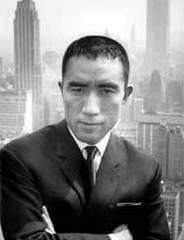
Yukio Mishima
Yukio Mishima

Yukio Mishima was a Japanese author and playwright, a prominent figure in post-war Japanese literature. His works, characterized by a fusion of traditional Japanese aesthetics and modernist techniques, often explored themes of tradition, ritual, and the samurai code. more

You May Also Like

“I understand it was Derian who spoiled everything. He purposefully tainted your view of me and forced you to go along with him. I know none of what happened was your idea or your desire, Eena.” She didn’t bother getting up, but spoke from her curled position. Her voice was weak, still heavy with despair. “Derian didn’t force me to do anything.” “But had he not influenced you, we would be enjoying a pleasant dinner again, telling stories and laughing. I’m sure that would be the case. You would be happy… and so would I.” Eena chuckled briefly without amusement. “You must admit we shared some enjoyable evenings, didn’t we? There’s really no reason we can’t put this whole mess behind us and start from where we left off.” He sounded genuinely serious. “You forget,” she reminded him, “I overheard your conversation with the Ghengats. This isn’t about Derian, it’s about you.” “Alright,” he admitted, sighing a sound of acquiescence, “so I’m not everything you’d hoped for. But really, what man can ever live up to a woman’s terribly high expectations?” This got her attention. She almost stood up to face him, but decided it wasn’t worth the effort. Leaning forward, she retorted, “Expecting a man to respect you, to be honest with you, and, oh yes, to not be a shameless murderer—I don’t think those are overly high expectations!” He shrugged, casually excusing his faults. “Nobody’s perfect.” “What do you want?” she finally asked with exasperation. He squatted to her level to state his desire. “I want you.” The expression on his face—the look in his weary blue eyes—appeared strangely sincere. But there was one thing Eena had learned from all of this: never trust a master of deceit.”

“She spun away from him and raced into the house toward her room to avoid an uncomfortable discussion. And as she flopped back on her bed and stared at the ceiling, she finally confronted the awful, alarming, dreadful, and entirely horrifying possibility that she had been rejecting all day. Though she could hardly accept it, she could no longer deny it. She was pretty sure Mr. Rodman was the King of Wands.”

“You made me who I am today, Nanni. Wherever I go, everyone I see and crave is ultimately measured by the glow of your light. If my life were a boat, you were the one who stepped on board, turned on its running lights, and was never heard from again. All this might as well be in my head, and in my head it stays. But I've lived and loved by your light alone. In a bus, on a busy street, in class, in a crowded concert hall, once or twice a year, whether for a man or a woman, my heart still jolts when I spot your look-alike. We love only once in our lives, my father had said, sometimes too early, sometimes too late; the other times are always a touch deliberate.”