Quotessence
Home / Quotes / Quote by Francis Bacon

Quote by Francis Bacon

“The human understanding is unquiet; it cannot stop or rest, and still presses onward, but in vain. Therefore it is that we cannot conceive of any end or limit to the world, but always as of necessity it occurs to us that there is something beyond... But he is no less an unskilled and shallow philosopher who seeks causes of that which is most general, than he who in things subordinate and subaltern omits to do so”

Quote by Francis Bacon

Work

The Great Instauration

This work delves into the philosophical underpinnings of the idea of a great restoration, examining the role of God in the process and its implications for the cosmos and humanity. more

Author
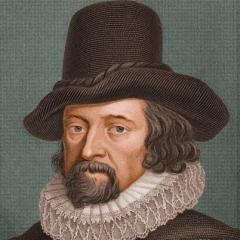
Francis Bacon
Francis Bacon

Francis Bacon, a renowned philosopher, politician, and writer, served as the Lord Chancellor of England. He is best known for his profound philosophical thoughts and extensive literary works, which have had a lasting impact on the world. more

You May Also Like

“Experience hobbles progress and leads to abandonment of difficult problems; it encourages the initiated to walk on the shady side of the street in the direction of experiences that have been pleasant. Youth without experience attacks the unsolved problems which maturer age with experience avoids, and from the labors of youth comes progress. Youth has dreams and visions, and will not be denied.”

“Stem cells are probably going to be extremely useful. But it isn't a given, and even if it were, I don't think the end justifies the means. I am not against stem cells, I think it's great. Blanket objection is not very reasonable to me-any effort to control scientific advances is doomed to fail. You cannot stop the human mind from working.”

“Considerable obstacles generally present themselves to the beginner, in studying the elements of Solid Geometry, from the practice which has hitherto uniformly prevailed in this country, of never submitting to the eye of the student, the figures on whose properties he is reasoning, but of drawing perspective representations of them upon a plane. ...I hope that I shall never be obliged to have recourse to a perspective drawing of any figure whose parts are not in the same plane.”