“Human experience, which is constantly contradicting theory, is the great test of truth. A system, built upon the discoveries of a great many minds, is always of more strength, than what is produced by the mere workings of any one mind, which, of itself, can do very little. There is not so poor a book in the world that would not be a prodigious effort were it wrought out entirely by a single mind, without the aid of prior investigators.”
Quote by Samuel Johnson
Work
Life of Johnson: Including Boswell's Journal of a Tour to the Hebrides and Johnson's Diary of a Journey Into North Wales
This book is a compilation of Samuel Johnson's biography, supplemented by James Boswell's account of their trip to the Hebrides islands and Johnson's own diary entries detailing his travels in North Wales. It offers insights into Johnson's life and thoughts, as well as a vivid depiction of the landscapes and cultures encountered during these journeys. more
Author
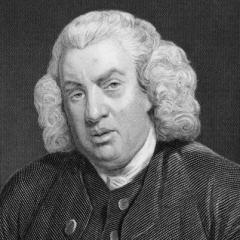
Samuel Johnson
Samuel Johnson was an English writer, poet, and lexicographer, renowned for his comprehensive English dictionary, 'A Dictionary of the English Language', published in 1755. His distinctive writing style and wit have cemented his place as a significant figure in the history of English literature. more
You May Also Like
“Nay, Sir, those who write in them, write well, in order to be paid well.”
Source: The life of Samuel Johnson, LL. D., comprehending an account of his studies, and numerous works, in chronological order: a series of his epistolary correspondence and conversations with many eminent persons; and various original pieces of his composition, never before published; the whole exhibiting a view of literature and literary men in Great Britain, for near half a century during which he flourished
Source: The Life of Samuel Johnson, LL. D.: Including a Journal of a Tour to the Hebrides
Source: The works of Samuel Johnson, LL.D.: Together with his life, and notes on his Lives of the poets, by Sir John Hawkins, Knt. In eleven volumes ...
Source: Essays from the Rambler, Adventurer, and Idler
Source: Selected poetry and prose
Source: The Rambler: A Periodical Paper, Published in 1750, 1751, 1752
“It is much easier not to write like a man than to write like a woman.”
Source: The Rambler: In Four Volumes..
Source: The Rambler: A Periodical Paper, Published in 1750, 1751, 1752