“Among the many inconsistencies which folly produces or infirmity suffers in the human mind, there has often been observed a manifest and striking contrariety between the life of an author and his writings... Those whom the appearance of virtue or the evidence of genius has tempted to a nearer knowledge of the writer, in whose performances they may be found, have indeed had frequent reason to repent their curiosity.”
Quote by Samuel Johnson
Work
Selected poetry and prose
This book compiles a selection of poetry and prose, offering readers a diverse array of literary expressions and narratives. The collection is intended to provide insight into the author's writing style and the various subjects explored within the works. more
Author
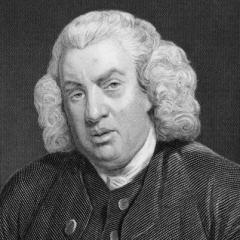
Samuel Johnson
Samuel Johnson was an English writer, poet, and lexicographer, renowned for his comprehensive English dictionary, 'A Dictionary of the English Language', published in 1755. His distinctive writing style and wit have cemented his place as a significant figure in the history of English literature. more
You May Also Like
Source: The Rambler: A Periodical Paper, Published in 1750, 1751, 1752
“It is much easier not to write like a man than to write like a woman.”
Source: The Rambler: In Four Volumes..
Source: The Rambler: A Periodical Paper, Published in 1750, 1751, 1752
Source: Samuel Johnson: Selected Writings
Source: Boswell's Life of Johnson: Including Boswell's Journal of a Tour of the Hebrides, and Johnson's Diary of A Journey Into North Wales
“A writer who obtains his full purpose loses himself in his own lustre.”
Source: The beauties of Johnson: choice selections from his works
Source: The works of the English poets, from Chaucer to Cowper
Source: The Lives of the English Poets