Quotessence
Home / Quotes / Quote by Elie Wiesel

Quote by Elie Wiesel

“At Auschwitz, not only man died, but also the idea of man. To live in a world where there is nothing anymore, where the executioner acts as god, as judge-many wanted no part of it. It was its own heart the world incinerated at Auschwitz.”

Quote by Elie Wiesel

Work

Legends of Our Time

This book compiles a series of short stories that delve into the diverse and intricate aspects of human life across different time periods, offering readers a glimpse into the multifaceted nature of existence. more

Author

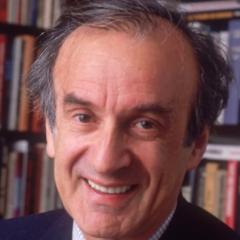
Elie Wiesel
Elie Wiesel

A renowned Jewish author and Nobel Peace Prize laureate, Elie Wiesel is known for his profound literary achievements and for recording and spreading the history of the Holocaust as a survivor. His works deeply reveal the terror of the Nazi Holocaust and the universal nature of human suffering. more

You May Also Like

“Cultural criticism finds itself faced with the final stage of the dialectic of culture and barbarism. To write poetry after Auschwitz is barbaric. And this corrodes even the knowledge of why it has become impossible to write poetry today. Absolute reification, which presupposed intellectual progress as one of its elements, is now preparing to absorb the mind entirely. Critical intelligence cannot be equal to this challenge as long as it confines itself to self-satisfied contemplation.”

“. . . What role does historiography play in the way a society and culture "remembers" past events? Does the historian have a moral or civic responsibility to this project of memory that ought to influence the way he or she engages in historical practice? Should moral concerns influence the historian's choice of subject matter, of issues to discuss, of evidence to use?”

“. . . the example given by the Nazi regime as to the ability of a modern state to destroy human lives with the same techniques used by modern industry, employing the bureaucratic apparatus readily available to any modern state, is one that can hardly be ignored. Because although history may not repeat itself, it is rare that anything introduced to human history is not used again. Whether the Holocaust was unique or not in terms of its precedents is one question; whether it will remain so is quite another.”

“. . . since being a Jew not only means that I bear within me a catastrophe that occurred yesterday and cannot be ruled out for tomorrow, it is-beyond being a duty-also fear. Every morning when I get up I can read the Auschwitz number on my forearm, something that touches the deepest and most closely intertwined roots of my existence; indeed I am not even sure if this is not my entire existence. Then I feel approximately as I did back then when I got a taste of the first blow from a policeman's fist. Every day anew I lose my trust in the world.”

“If the people we love are stolen from us, the way to have them live on is to never stop loving them. Buildings burn, people die, but real love is forever.”