Quotessence
Home / Quotes / Quote by Thomas Malthus

Quote by Thomas Malthus

“Where there are few people, and a great quantity of fertile land, the power of the earth to afford a yearly increase of food may be compared to a great reservoir of water, supplied by a moderate stream. The faster population increases, the more help will be got to draw off the water, and consequently an increasing quantity will be taken every year. But the sooner, undoubtedly, will the reservoir be exhausted, and the streams only remain.”

Quote by Thomas Malthus

Work

An Essay on the Principle of Population and Other Writings

An Essay on the Principle of Population is a foundational text that examines the impact of population size on economic and social systems. The book delves into the dynamics of population growth, the distribution of resources, and the implications for society. It also encompasses other writings by the author that further explore these themes. more

Author
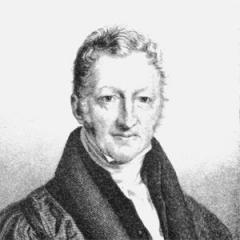
Thomas Malthus
Thomas Malthus

Thomas Malthus, a British economist and demographer, was born on February 14, 1766, in Surrey, England, and died on December 23, 1834. Malthus is known for his theory of population, which posits that population growth will outstrip food supply, leading to poverty and suffering. more

You May Also Like

“The redundant population, necessarily occasioned by the prevalence of early marriages, must be repressed by occasional famines, and by the custom of exposing children, which, in times of distress, is probably more frequent than is ever acknowledged to Europeans.”

“No state has hitherto existed (at least that we have any account of) ... that no check whatever has existed to early marriages, among the lower classes, from a fear of not providing well for their families, or among the higher classes, from a fear of lowering their condition in life.”

“The moment we face it frankly we are driven to the conclusion that the community has a right to put a price on the right to live in it ... If people are fit to live, let them live under decent human conditions. If they are not fit to live, kill them in a decent human way. Is it any wonder that some of us are driven to prescribe the lethal chamber as the solution for the hard cases which are at present made the excuse for dragging all the other cases down to their level, and the only solution that will create a sense of full social responsibility in modern populations?”

“The notion that persons should be safe from extermination as long as they do not commit willful murder, or levy war against the Crown, or kidnap, or throw vitriol, is not only to limit social responsibility unnecessarily, and to privilege the large range of intolerable misconduct that lies outside them, but to divert attention from the essential justification for extermination, which is always incorrigible social incompatibility and nothing else.”

“I believe that now and always the conscious selection of the best for reproduction will be impossible; that to propose it is to display a fundamental misunderstanding of what individuality implies. The way of nature has always been to slay the hindmost, and there is still no other way, unless we can prevent those who would become the hindmost being born. It is in the sterilization of failure, and not in the selection of successes for breeding, that the possibility of an improvement of the human stock lies.”

“We should not minimize the great outstanding service of Eugenics for critical and diagnostic investigations. It demonstrates ... that uncontrolled fertility is universally correlated with disease, poverty, overcrowding and the transmission of hereditable traits.”

“We are paying for and even submitting to the dictates of an ever increasing, unceasingly spawning class of human beings who never should have been born at all-that the wealth of individuals and of state is being diverted from the development and the progress of human expression and civilization.”

“Every single case of inherited defect, every malformed child, every congenitally tainted human being brought into this world is of infinite importance to that poor individual; but it is of scarcely less importance to the rest of us and to all of our children who must pay in one way or another for these biological and racial mistakes.”