“The sphere to end all spheres—the largest and most perfect of them all—is the entire observable universe. In every direction we look, galaxies recede from us at speeds proportional to their distance. As we saw in the first few chapters, this is the famous signature of an expanding universe, discovered by Edwin Hubble in 1929. When you combine Einstein’s relativity and the velocity of light and the expanding universe and the spatial dilution of mass and energy as a consequence of that expansion, there is a distance in every direction from us where the recession velocity for a galaxy equals the speed of light. At this distance and beyond, light from all luminous objects loses all its energy before reaching us. The universe beyond this spherical “edge” is thus rendered invisible and, as far as we know, unknowable. There’s a variation of the ever-popular multiverse idea in which the multiple universes that comprise it are not separate universes entirely, but isolated, non-interacting pockets of space within one continuous fabric of space-time—like multiple ships at sea, far enough away from one another so that their circular horizons do not intersect. As far as any one ship is concerned (without further data), it’s the only ship on the ocean, yet they all share the same body of water.”
Quote by Neil deGrasse Tyson
Work
This book provides a succinct and accessible introduction to the fundamental principles of astrophysics, covering topics such as the structure of the universe, black holes, and the nature of dark matter. more
Author
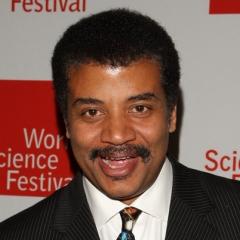
Neil deGrasse Tyson is an American astrophysicist, science communicator, and television personality. Born on October 5, 1958, he is renowned for his deep understanding of the cosmos and his ability to popularize scientific knowledge. Tyson grew up in New York City and earned a Ph.D. in astronomy from Columbia University. He served as the director of the Hayden Planetarium at the American Museum of Natural History and has been a member of various scientific committees. more
You May Also Like
“I will not ignore you. l will just close your chapter like you were never part of the story.”