Quotessence
Home / Quotes / Quote by Emmeline Pankhurst

Quote by Emmeline Pankhurst

“I want to say right here, that those well-meaning friends on the outside who say that we have suffered these horrors of prison, of hunger strikes and forcible feeding, because we desired to martyrise ourselves for the cause, are absolutely and entirely mistaken. We never went to prison in order to be martyrs. We went there in order that we might obtain the rights of citizenship. We were willing to break laws that we might force men to give us the right to make laws.”

Quote by Emmeline Pankhurst

Author
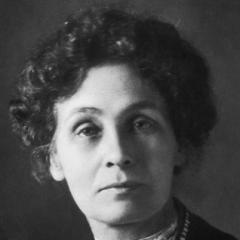
Emmeline Pankhurst
Emmeline Pankhurst

Emmeline Pankhurst was a British suffragette leader who was instrumental in the women's suffrage movement. Born on July 15, 1858, she dedicated her life to the fight for women's right to vote. Pankhurst's leadership and the WSPU's aggressive tactics, including demonstrations, hunger strikes, and acts of civil disobedience, were crucial in gaining public support and media attention. Her efforts led to the Representation of the People Act 1918, which granted some women the right to vote. more

You May Also Like

“My conduct in the Free Trade Hall and outside was meant as a protest against the legal position of women today. We cannot make any orderly protest because we have not the means whereby citizens may do such a thing; we have not a vote; and so long as we have not votes we must be disorderly. There is no other way whereby we can put forward our claims to political justice. When we have that you will not see us at the police courts; but so long as we have not votes this will happen.”

“Anti-pornography (or radical) feminists will consider me a heretic-fit only for burning. Or, to put it in more politically correct terms, I am a woman who is so psychologically damaged by patriarchy that I have fallen in love with my own oppression. My arguments will be dismissed. In other words, if I enjoy pornography, it is not because I am a unique human being with different preferences. It is because I am psychologically ill.”

“In the social turbulence following the Civil War, thousands of men and women enlisted in a purity campaign. They sought to establish a single standard of sexual morality for both sexes. This was not a drive for greater freedom; it was a puritanical campaign to narrow the choices of individuals down to socially acceptable ones.”

“This is the second way in which women in the industry are said to be victims of violence. They are said to be so brainwashed by white male culture that they cannot render consent. Thus, they are de facto coerced. Consider how arrogant this statement is. Although women in pornography appear to be willing, anti-porn feminists see through this charade [...] If a woman enjoys performing sex acts in front of a camera, it is not because she is a unique human being who reasons and reacts from a different background or personality. No. It is because she is psychologically damaged and no longer responsible for her actions. She must, in effect, become a political ward of radical feminists, who will make the correct choices for her.”

“If a man loves a girl who is in the first place young and inexperienced; who in the second place is educated with a background of caveman tradition, a middle-ground of poetry and romance, and a foreground of unspoken hope and interest all centering upon the one Event; and who has, furthermore, absolutely no other hope or interest worthy of the name - why, it is a comparatively easy manner to sweep her off her feet with a dashing attack.”

“What is a “woman”? Who gets to be one? Who gets to decide who “counts”? In our quest for equality, should feminists strive for the right to embody even the toxic aspects of masculinity, or should we focus on dismantling it before reaching for equality at all? Why should women who have traditionally been underserved or exploited by mainstream feminism (women of colour, trans women, sex workers) have that label foisted upon them? What do we do with the uncomfortable truth that many women’s rights pioneers were explicitly, actively racist? How do we honour their contributions without erasing the oppression of women of colour that still taints feminism today? How do we reconcile the tension between celebrating womanhood and rejecting gender essentialism? How do we reconcile the tension between fighting oppressive beauty standards and wanting to express ourselves through makeup and clothes?”