Quotessence
Home / Quotes / Quote by Anaxagoras

Quote by Anaxagoras

“Neither is there a smallest part of what is small, but there is always a smaller (for it is impossible that what is should cease to be). Likewise there is always something larger than what is large.”

Quote by Anaxagoras

Author
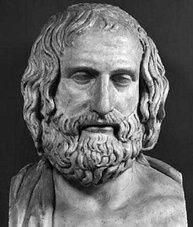
Anaxagoras
Anaxagoras

Anaxagoras, born around 500 BC and died in 428 BC, was a renowned Greek philosopher. He is considered one of the pioneers of atomism, proposing the theory that all things are composed of infinite small particles called 'seeds'. Anaxagoras' philosophical ideas had a profound impact on later generations, especially in the field of natural sciences. more

You May Also Like

“One summer day, while I was walking along the country road on the farm where I was born, a section of the stone wall opposite me, and not more than three or four yards distant, suddenly fell down. Amid the general stillness and immobility about me the effect was quite startling. ... It was the sudden summing up of half a century or more of atomic changes in the material of the wall. A grain or two of sand yielded to the pressure of long years, and gravity did the rest.”

“Probably our atomic weights merely represent a mean value around which the actual atomic weights of the atoms vary within certain narrow limits... when we say, the atomic weight of, for instance, calcium is 40, we really express the fact that, while the majority of calcium atoms have an actual atomic weight of 40, there are not but a few which are represented by 39 or 41, a less number by 38 or 42, and so on.”

“The most startling result of Faraday's Law is perhaps this. If we accept the hypothesis that the elementary substances are composed of atoms, we cannot avoid concluding that electricity also, positive as well as negative, is divided into definite elementary portions, which behave like atoms of electricity.”

“The story is told of Lord Kelvin, a famous Scotch physicist of the last century, that after he had given a lecture on atoms and molecules, one of his students came to him with the question, "Professor, what is your idea of the structure of the atom." "What," said Kelvin, "The structure of the atom? Why, don't you know, the very word 'atom' means the thing that can't be cut. How then can it have a structure?" "That," remarked the facetious young man, "shows the disadvantage of knowing Greek."”