“He was, I take it, the most perfect reasoning and observing machine that the world has seen, but as a lover he would have placed himself in a false position. He never spoke of the softer passions, save with a gibe and a sneer. They were admirable things for the observer- excellent for drawing the veil from men's motives and actions. But for the trained observer to admit such intrusions into his own delicate and finely adjusted temperament was to introduce a distracting factor which might throw a doubt upon all his mental results. Grit in a sensitive instrument, or a crack in one of his own high-power lenses, would not be more disturbing than a strong emotion in a nature such as his.”
Quote by Arthur Conan Doyle
Work
The Complete Sherlock Holmes
This book includes all the original Sherlock Holmes stories written by Sir Arthur Conan Doyle, presenting a full picture of the iconic detective's adventures and investigations. more
Author
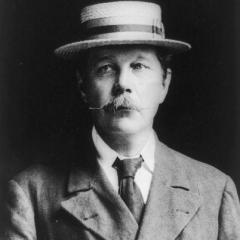
Arthur Conan Doyle
Arthur Conan Doyle, born on May 22, 1859 in Edinburgh, Scotland, was a renowned Scottish physician and writer. He is best known for his creation of the Sherlock Holmes series of detective novels, which have had a profound impact on the development of detective fiction and played a crucial role in shaping modern detective culture. more
You May Also Like
“One can accomplish something only so long as one cannot accomplish everything.”
Source: The Cyberiad
“Man is a play station whereas a woman will always remain at an emotion station.”
Source: Adventus
“There's no such thing as emotion. It's only body chemistry in action.”
Source: My Ancestor Was an Ancient Astronaut
“It seems my heart is made of tissue paper; I wish the world would handle it more delicately.”
Source: A Heart Made of Tissue Paper
Source: The Positive Philosophy
Source: Your erroneous zones
“One of the most effective ways of changing the way people think is to change the way they worship.”
Source: Reformation Thought: An Introduction
Source: Japanese Yoga: The Way of Dynamic Meditation