Quotessence
Home / Quotes / Quote by Yanis Varoufakis

Quote by Yanis Varoufakis

“... toxic derivatives were underpinned by toxic economics, which, in turn, were no more than motivated delusions in search of theoretical justification; fundamentalist tracts that acknowledged facts only when they could be accommodated to the demands of the lucrative faith. Despite their highly impressive labels and technical appearance, economic models were merely mathematized versions of the touching superstition that markets know best, both at times of tranquility and in periods of tumult.”

Quote by Yanis Varoufakis

Work

The Global Minotaur: America, Europe and the Future of the Global Economy

This book delves into the economic dynamics between the United States and Europe, examining their roles and the future implications for the global economy. more

Author
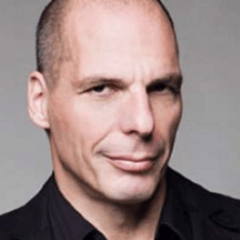
Yanis Varoufakis
Yanis Varoufakis

Yanis Varoufakis is a Greek economist and politician who served as the Finance Minister of Greece from 2015 to 2015. He is known for his role in the Greek debt crisis and his advocacy for a more democratic economic system. more

You May Also Like

“She could envision Jesus out on the stormy waves calling her to join him, and not to depend on the laws of nature. She’d just need to keep her focus on the Savior and move forward in these tossing waves. To keep looking down on the watery sprays trying to sink her would be her undoing. As her father understood and often repeated, she now saw the storm warning. “You win some, you lose some.” Could Jesus defy natural endings?”

“She could envision Jesus out on the stormy waves calling her to join him, and not be distracted by the laws of nature. She’d just need to keep her focus on the Savior and move forward in these tossing waves. To keep focusing on the watery sprays trying to sink her would be her undoing. As her father understood and often repeated, she now saw the storm warning. “You win some, you lose some.” Could Jesus defy natural consequences-gravity?”

“Only with our modern civilization did we find ourselves forcibly inducted into this individual existence. Of course, we fight to retain this 'inalienable' right, and we are naturally driven to win it and defend it at all costs. We demand this freedom, this autonomy, as a fundamental human right and, at the same time, we are crippled by the responsibility that ends up making us detest ourselves as such. This is what resounds in the complaint of Job. God asks too much: ''What is man, that thou shouldest magnify him? And that thou shouldest set thy heart upon him? And that thou shouldest visit him every morning, and try him every moment? How long wilt thou not depart from me, nor let me alone till I swallow down my spittle? ' This leaves us subject to a contradictory twofold requirement: to seek an identity by all possible means - by hounding the identities of others or by exploring the networks - and to slough off identity in every possible way, as though it were a burden or a disguise. It is as though liberty and individuality, from having been a 'natural' state in which one may act freely, had become artificial states, a kind of moral imperative, whose implacable decree makes us hostages to our identities and our own wills. This is a very particular case of Stockholm Syndrome, since we are here both the terrorist and the hostage. Now, the hostage is by definition the unexchangeable, accursed object you cannot be rid of because you don't know what to do with it. The situation is the same for the subject: as hostage to himself, he doesn't know how to exchange himself or be rid of himself.”