Quotessence
Home / Quotes / Quote by Thomas More

Quote by Thomas More

“but in Utopia, where every man has a right to everything, they all know that if care is taken to keep the public stores full no private man can want anything; for among them there is no unequal distribution, so that no man is poor, none in necessity, and though no man has anything, yet they are all rich; for what can make a man so rich as to lead a serene and chreerful life, free from anxieties; neither apprehending want himself, nor vexed with the endless complaints of his wife?”

Quote by Thomas More

Book:Utopia

Work

Utopia

Written by Sir Thomas More, this book presents a fictional island society that serves as a model for an ideal community, examining political, social, and religious aspects of life. more

Author

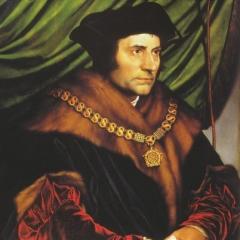
Thomas More
Thomas More

Thomas More, born on February 7, 1478, in London, England, and died on July 6, 1535. He was a renowned humanist, politician, philosopher, and writer in the English Renaissance, best known for his work 'Utopia'. During the reign of Henry VIII, More held several important positions, including Lord Chancellor and Chancellor of the Exchequer. His political ideas and social ideals have had a profound impact on the world. more

You May Also Like

“The First Mobile, if one is sent, must be warned that unless he is very self-assured, or senile, his pride will suffer. A man wants his virility regarded, a woman wants her femininity appreciated, however indirect and subtle the indications of regard and appreciation. On Winter they will not exist. One is respected and judged only as a human being. It is an appalling experience.”

“All my moral and intellectual being is penetrated by an invincible conviction that whatever falls under the dominion of our senses must be in nature and, however exceptional, cannot differ in its essence from all the other effects of the visible and tangible world of which we are a self-conscious part. The world of the living contains enough marvels and mysteries as it is—marvels and mysteries acting upon our emotions and intelligence in ways so inexplicable that it would almost justify the conception of life as an enchanted state. No, I am too firm in my consciousness of the marvelous to be ever fascinated by the mere supernatural which . . . is but a manufactured article, the fabrication of minds insensitive to the intimate delicacies of our relation to the dead and to the living, in their countless multitudes; a desecration of our tenderest memories; an outrage on our dignity.”

“The problem, however, is that I have yet to meet anyone, materialist or otherwise, who was able to dispense with value judgements. On the contrary, the literature of materialism is peculiarly marked by its wholesale profusion of denunciations of all sorts. Starting with Marx and Nietzsche, materialists have never been able to refrain from passing continuous moral judgement on all and sundry, which their whole philosophy might be expected to discourage them from doing.”

“It portrayed motherhood as the highest position that a woman could achieve. For God had made Mary neither a prophet nor the messiah nor the daughter of God. Nor did God take the form of a woman. She was only the womb. She was a perpetual virgin too, and she endured the vilest harassment because of it, or so the story went. Rebecca couldn’t relate to the Virgin Mary at all.”

“We are both preachers. He preached the teaching of Jesus Christ, and I preached my philosophy. He asked me: “Do you pray?” “No.” “Do you beseech God to forgive your trespasses?” “No.” “Do you not thank God for his bounty?” “No.” “Do you not depend on God's support?” “No.” And with this his puzzlement increased until he was assured that my fate lies in hell indeed.”

“The foundation of irreligious criticism is: Man makes religion, religion does not make man. Religion is, indeed, the self-consciousness and self-esteem of man who has either not yet won through to himself, or has already lost himself again. But man is no abstract being squatting outside the world. Man is the world of man – state, society. This state and this society produce religion, which is an inverted consciousness of the world, because they are an inverted world. Religion is the general theory of this world, its encyclopaedic compendium, its logic in popular form, its spiritual point d’honneur, its enthusiasm, its moral sanction, its solemn complement, and its universal basis of consolation and justification. It is the fantastic realization of the human essence since the human essence has not acquired any true reality. The struggle against religion is, therefore, indirectly the struggle against that world whose spiritual aroma is religion. Religious suffering is, at one and the same time, the expression of real suffering and a protest against real suffering. Religion is the sigh of the oppressed creature, the heart of a heartless world, and the soul of soulless conditions. It is the opium of the people. The abolition of religion as the illusory happiness of the people is the demand for their real happiness. To call on them to give up their illusions about their condition is to call on them to give up a condition that requires illusions. The criticism of religion is, therefore, in embryo, the criticism of that vale of tears of which religion is the halo. Criticism has plucked the imaginary flowers on the chain not in order that man shall continue to bear that chain without fantasy or consolation, but so that he shall throw off the chain and pluck the living flower. The criticism of religion disillusions man, so that he will think, act, and fashion his reality like a man who has discarded his illusions and regained his senses, so that he will move around himself as his own true Sun. Religion is only the illusory Sun which revolves around man as long as he does not revolve around himself. It is, therefore, the task of history, once the other-world of truth has vanished, to establish the truth of this world. It is the immediate task of philosophy, which is in the service of history, to unmask self-estrangement in its unholy forms once the holy form of human self-estrangement has been unmasked. Thus, the criticism of Heaven turns into the criticism of Earth, the criticism of religion into the criticism of law, and the criticism of theology into the criticism of politics.”