Quotessence
Home / Quotes / Quote by Malcolm X

Quote by Malcolm X

“It's like the Negro in America seeing the white man win all the time. He's a professional gambler; he has all the cards and the odds stacked on his side, and he has always dealt to our people from the bottom of the deck.”

Quote by Malcolm X

Work

The Autobiography of Malcolm X

The Autobiography of Malcolm X is a first-person account of the life of Malcolm X, a prominent figure in the civil rights movement. The book covers his early life in rural Nebraska, his migration to New York City, his involvement with the Nation of Islam, and his subsequent evolution in his views on race and civil rights. The narrative is a candid look at his personal journey, his rise to prominence, and his eventual assassination. more

Author
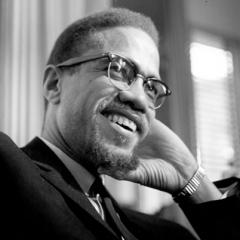
Malcolm X
Malcolm X

Malcolm X was a prominent human rights activist, born on May 19, 1925, and died on February 21, 1965. He played a significant role in the civil rights movement, advocating for black self-liberation and rights. His ideas and actions have had a profound impact on future generations. more

You May Also Like

“Any Black person in amerika, if they are honest with themselves, have got to come to the conclusion that they don’t know what it feels like to be free. We aren’t free politically, economically, or socially. We have very little power over what happens in our lives. In fact, a Black person in amerika isn’t even free to walk down the street. Walk down the wrong street, in the wrong neighborhood at night, and you know what happens.”

“Instead of a mass movement saying 'No, we don't want [police],' the mass movement is saying 'How do we reform them? How do we hold a couple of them accountable?' The conversation should be: 'Why are they even here?' There are obviously many of us who have had that conversation, but it hasn't been the popular dialogue. Why do the police even exist? What are their origins? Many of us understand that their original task was to patrol slaves. Many of us understand that the first sheriff's department patrolled the US-Mexico border. That's not the public discourse. This has everything to do with the position that they've played in the last thirty years. It's also deeply rooted in anti-Black racism. The idea of not having police scares people. People say, 'What are we going to do with criminals?' by which they mean 'What are we going to do with Black people?' I believe we should abolish the police. I think they are extremely dangerous and will continue to be. That doesn't mean I don't believe in police reform...We do have to deal with the current crisis in the short term. That's important. We have to have solutions for people's real-life problems, and we have to allow people to decide what those solutions are. We also have to create a vision that's much bigger than the one we have right now. I was talking to one of the organizers in Ferguson. I said to her, this work is bigger than us. It's bigger than Black people. It's bigger than humans. This is a planetary crisis. If we don't solve it or at least set up a system that can help solve it, I don't think we'll survive.”

“Jeremy Bentham argued that 'even in the best of times the great mass of citizens will most probably possess few resources other than their daily labour and, consequently, be always near indigence'. As long as working man was near indigence, hunger would remain an effective tool to goad him to labour. Bentham argued that an important task of government was to ensure conditions of deprivation, thereby guaranteeing that hunger would [be a constant motivation to work].”