Quotessence
Home / Quotes / Quote by Ambrose Bierce

Quote by Ambrose Bierce

“Past, n. That part of Eternity with some small fraction of which we have a slight and regrettable acquaintance. A moving line called the Present parts it from an imaginary period known as the Future. These two grand divisions of Eternity, of which the one is continually effacing the other, are entirely unlike. The one is dark with sorrow and disappointment, the other bright with prosperity and joy.... Yet the Past is the Future of yesterday, the Future is the Past of to-morrow. They are one-the knowledge and the dream.”

Quote by Ambrose Bierce

Work

The Devil's Dictionary: The Devil World

This book is a compilation of satirical definitions, offering a humorous and critical take on a wide range of words and ideas, all presented from the viewpoint of a devil. The entries are known for their wit and sarcasm, challenging the reader's understanding of common terms and concepts. more

Author
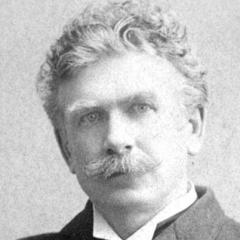
Ambrose Bierce
Ambrose Bierce

Ambrose Bierce was an American journalist, satirist, and editor, renowned for his sharp wit and dark humor. He is best known for his satirical novel 'The Devil's Dictionary' and his short stories. Bierce was born on June 24, 1842, and his exact date of death remains unknown, as he disappeared during the American Civil War. more

You May Also Like

“For if that last day does not occasion an entire extinction, but a change of abode only, what can be more desirable? And if it, on the other hand, destroys and absolutely puts an end to us, what can be preferable to having a deep sleep fall on us in the midst of the fatigues of life and, being thus overtaken, to sleep to eternity?”

“If the oarsmen of a fast-moving ship suddenly cease to row, the suspension of the driving force of the oars doesn't prevent the vessel from continuing to move on its course. And with a speech it is much the same. After he has finished reciting the document, the speaker will still be able to maintain the same tone without a break, borrowing its momentum and impulse from the passage he has just read out.”

“The most evident difference between man and animals is this: the beast, in as much as it is largely motivated by the senses and with little perception of the past or future, lives only for the present. But man, because he is endowed with reason by which he is able to perceive relationships, sees the causes of things, understands the reciprocal nature of cause and effect, makes analogies, easily surveys the whole course of his life, and makes the necessary preparations for its conduct.”