Quotessence
Home / Quotes / Quote by Georg C. Lichtenberg

Quote by Georg C. Lichtenberg

Author

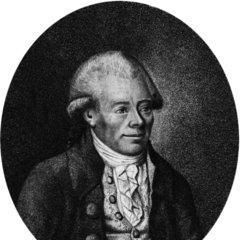
Georg C. Lichtenberg

German physicist, inventor, and writer, known for his research in electricity and magnetism. He proposed Lichtenberg's law in electricity and invented various scientific instruments. more

You May Also Like

“I claim that many patterns of Nature are so irregular and fragmented, that, compared with Euclid - a term used in this work to denote all of standard geometry - Nature exhibits not simply a higher degree but an altogether different level of complexity ... The existence of these patterns challenges us to study these forms that Euclid leaves aside as being "formless," to investigate the morphology of the "amorphous."”

“Science is the study of the admitted laws of existence, which cannot prove a universal negative about whether those laws could ever be suspended by something admittedly above them. It is as if we were to say that a lawyer was so deeply learned in the American Constitution that he knew there could never be a revolution in America.”

“The attainment of knowledge is the high and exclusive attribute of man, among the numberless myriads of animated beings, inhabitants of the terrestrial globe. On him alone is bestowed, by the bounty of the Creator of the universe, the power and the capacity of acquiring knowledge. Knowledge is the attribute of his nature which at once enables him to improve his condition upon earth, and to prepare him for the enjoyment of a happier existence hereafter.”

“The theory I propose may therefore be called a theory of the Electromagnetic Field because it has to do with the space in the neighbourhood of the electric or magnetic bodies, and it may be called a Dynamical Theory, because it assumes that in the space there is matter in motion, by which the observed electromagnetic phenomena are produced.”

“To mean understandings, it is sufficient honour to be numbered amongst the lowest labourers of learning; but different abilities must find different tasks. To hew stone, would have been unworthy of Palladio; and to have rambled in search of shells and flowers, had but ill suited with the capacity of Newton.”

“England and all civilised nations stand in deadly peril of not having enough to eat. As mouths multiply, food resources dwindle. Land is a limited quantity, and the land that will grow wheat is absolutely dependent on difficult and capricious natural phenomena... I hope to point a way out of the colossal dilemma. It is the chemist who must come to the rescue of the threatened communities. It is through the laboratory that starvation may ultimately be turned into plenty... The fixation of atmospheric nitrogen is one of the great discoveries, awaiting the genius of chemists.”