Quotessence
Home / Quotes / Quote by Albert Camus

Quote by Albert Camus

Work

The Myth of Sisyphus

Albert Camus' seminal work delves into the existentialist philosophy, examining the absurdity of life and the human struggle against it through the allegory of Sisyphus, a figure from Greek mythology who is eternally condemned to roll a boulder up a hill only to have it roll back down again. more
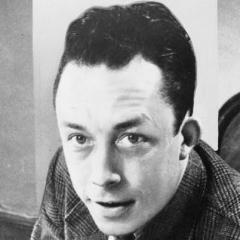
Author

Albert Camus
Albert Camus

Albert Camus was a French author and philosopher, born on November 7, 1913, and died on January 4, 1960. Known for his unique existentialist philosophy and profound insights into human suffering, Camus' works include 'The Stranger', 'The Plague', and 'The Myth of Sisyphus', which have had a profound impact on 20th-century literature. more

You May Also Like

“You yearn to stay in this in-between place, where the beauty of the times you have freshly bade farewell to is still alive and vivid in your mind – almost real – and the reality of your new circumstances has yet to fully sink in. You listen to the familiar melodies that had accompanied you on your journey, and allow the music to evoke landscapes and scenes in your mind. The songs caress your sub-consciousness and fill your being with an airy joy. You are both here and elsewhere. Or perhaps you are everywhere and nowhere.”

“And yet, about two weeks after his arrival, all I wanted every night was for him to leave his room, not via its front door, but through the French windows on our balcony. I wanted to hear his window open, hear his espadrilles on the balcony, and then the sound of my own window, which was never locked, being pushed open as he’d step into my room after everyone had gone to bed, slip under my covers, undress me without asking, and after making me want him more than I thought I could ever want another living soul, gently, softly, and, with the kindness one Jew extends to another, work his way into my body, gently and softly, after heeding the words I’d been rehearsing for days now, Please, don’t hurt me, which meant, Hurt me all you want.”

“We do not content ourselves with the life we have in ourselves and in our own being; we desire to live an imaginary life in the mind of others, and for this purpose we endeavour to shine. We labour unceasingly to adorn and preserve this imaginary existence, and neglect the real. And if we possess calmness, or generosity, or truthfulness, we are eager to make it known, so as to attach these virtues to that imaginary existence. We would rather separate them from ourselves to join them to it; and we would willingly be cowards in order to acquire the reputation of being brave. A great proof of the nothingness of our being, not to be satisfied with the one without the other, and to renounce the one for the other! For he would be infamous who would not die to preserve his honour.”

“The tangible and factual components of reality along with the intangible strands of memory and imagination constitute the framework that houses our vital life force. A person is likewise composed of contradictory and complementary forces of pain and pleasure, darkness and lightness, and clashing and harmonizing bands of thoughts and feelings. The web and root of all persons consists of both the expressible and the unsayable. Who has not held imaginary conversations with gods, devils, and spirits? Persons whom enthusiastically cultivate an inner life, ardently experience the quick of nature, and willingly immerse themselves in all aspects of everyday living will experience renewal. Analogous to the heat source of fire, we need the spark of desire to fuel our hearts and the spirit of the breeze to spread our heart songs.”

“Now there was only one hope, the sovereign grace of God. God would have to transform my heart to do what a heart cannot make itself do, namely, want what it ought to want. Only God can make the depraved heart desire God. Once when Jesus’ disciples wondered about the salvation of a man who desired money more than God, he said to them, “With man it is impossible, but not with God. For all things are possible with God” (Mark 10:27). Pursuing what we want is possible. It is easy. It is a pleasant kind of freedom. But the only freedom that lasts is pursuing what we want when we want what we ought. And it is devastating to discover we don’t, and we can’t.”

“A true saying it is, ‘Desire hath no rest;‘ is infinite in itself, endless; and as one calls it, a perpetual rack, or horse-mill, according to Austin, still going round as in a ring.”