Quotessence
Home / Quotes / Quote by Ken Wilber

Quote by Ken Wilber

“Most of us are only willing to call 5% of our present information into question any one point.”

Quote by Ken Wilber

Author
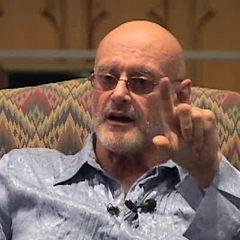
Ken Wilber
Ken Wilber

Ken Wilber is an American writer and philosopher, born on January 31, 1949. He is the founder of Integral Theory, which aims to integrate human knowledge, philosophy, psychology, and religion. Wilber's work covers a wide range of fields, including personal growth, spiritual development, and cultural studies. more

You May Also Like

“A language possesses utility only insofar as it can construct conventional boundaries. A language of no boundaries is no language at all, and thus the mystic who tries to speak logically and formally of unity consciousness is doomed to sound very paradoxical or contradictory. The problem is that the structure of any language cannot grasp the nature of unity consciousness, any more than a fork could grasp the ocean.”

“Meditation, then, is not so much a part of this or that particular religion, but rather part of the universal spiritual culture of all humankind--an effort to bring awareness to bear on all aspects of life. It is, in other words, part of what has been called the perennial philosophy.”

“The integral approach is committed to the full spectrum of consciousness as it manifests in all its extraordinary diversity. This allows the integral approach to recognize and honor the Great Holarchy of Being first elucidated by the perennial philosophy and the great wisdom traditions in general... The integral vision embodies an attempt to take the best of both worlds, ancient and modern. But that demands a critical stance willing to reject unflinchingly the worst of both as well.”

“In other words, the real problem is not exterior. The real problem is interior. The real problem is how to get people to internally transform, from egocentric to sociocentric to worldcentric consciousness, which is the only stance that can grasp the global dimensions of the problem in the first place, and thus the only stance that can freely, even eagerly, embrace global solutions.”

“Global consciousness is not an objective belief that can be taught to anybody and everybody, but a subjective transformation in the interior structures that can hold belief in the first place, which itself is the product of a long line of inner consciousness development.”

“Saving the biosphere depends first and foremost on human beings reaching mutual understanding and unforced agreement as to common ends. And that intersubjective accord occurs only in the noosphere. Anything short of that noospheric accord will continue to destroy the biosphere.”