Quotessence
Home / Quotes / Quote by Milton Friedman

Quote by Milton Friedman

“Keynes was a great economist. In every discipline, progress comes from people who make hypotheses, most of which turn out to be wrong, but all of which ultimately point to the right answer. Now Keynes, in 'The General Theory of Employment, Interest and Money,' set forth a hypothesis which was a beautiful one, and it really altered the shape of economics. But it turned out that it was a wrong hypothesis. That doesn't mean that he wasn't a great man!”

Quote by Milton Friedman

Author
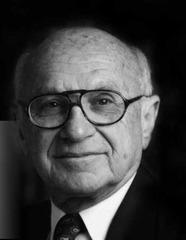
Milton Friedman
Milton Friedman

Milton Friedman was a renowned economist known for his contributions to the field of free-market economics. His research in monetary economics, consumer behavior, and tax policy has had a profound impact. more

You May Also Like

“Our minds tell us, and history confirms, that the great threat to freedom is the concentration of power. Government is necessary to preserve our freedom, it is an instrument through which we can exercise our freedom; yet by concentrating power in political hands, it is also a threat to freedom. Even though the men who wield this power initially be of good will and even though they be not corrupted by the power they exercise, the power will both attract and form men of a different stamp.”

“Political freedom means the absence of coercion of a man by his fellow men. The fundamental threat to freedom is power to coerce, be it in the hands of a monarch, a dictator, an oligarchy, or a momentary majority. The preservation of freedom requires the elimination of such concentration of power to the fullest possible extent and the dispersal and distribution of whatever power cannot be eliminated — a system of checks and balances.”

“The key insight of Adam Smith's Wealth of Nations is misleadingly simple: if an exchange between two parties is voluntary, it will not take place unless both believe they will benefit from it. Most economic fallacies derive from the neglect of this simple insight, from the tendency to assume that there is a fixed pie, that one party can gain only at the expense of another.”

“It shouldn't be the consumer's responsibility to figure out what's cruel and what's kind, what's environmentally destructive and what's sustainable. Cruel and destructive food products should be illegal. We don't need the option of buying children's toys made with lead paint, or aerosols with chlorofluorocarbons, or medicines with unlabeled side effects. And we don't need the option of buying factory-farmed animals.”