Quotessence
Home / Quotes / Quote by Thomas Jefferson

Quote by Thomas Jefferson

Work

Thomas Jefferson: Thoughts on War and Revolution : Annotated Correspondence

The book features a comprehensive selection of Jefferson's letters and documents, providing insight into his views on military strategy, political philosophy, and the principles of the American Revolution. more

Author
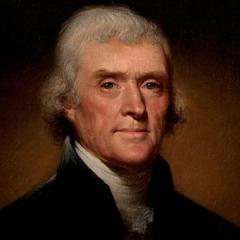
Thomas Jefferson
Thomas Jefferson

Thomas Jefferson was the third President of the United States, a distinguished politician, philosopher, architect, and scientist. He was born on April 13, 1743, and died on July 4, 1826. Jefferson advocated for democracy and freedom in politics and was one of the main authors of the Declaration of Independence. His political ideas had a profound impact on the founding and development of the United States. more

You May Also Like

“As on the one hand, the necessity for borrowing in particular emergencies cannot be doubted, so on the other, it is equally evident that to be able to borrow upon good terms, it is essential that the credit of a nation should be well established.”

“It is a wise rule and should be fundamental in a government disposed to cherish its credit, and at the same time to restrain the use of it within the limits of its faculties, "never to borrow a dollar without laying a tax in the same instant for paying the interest annually, and the principal within a given term; and to consider that tax as pledged to the creditors on the public faith."”

“But with respect to future debt; would it not be wise and just for that nation to declare in the constitution they are forming that neither the legislature, nor the nation itself can validly contract more debt, than they may pay within their own age, or within the term of 19 years.”

“There is not a more important and fundamental principle in legislation, than that the ways and means ought always to face the public engagements; that our appropriations should ever go hand in hand with our promises. To say that the United States should be answerable for twenty-five millions of dollars without knowing whether the ways and means can be provided, and without knowing whether those who are to succeed us will think with us on the subject, would be rash and unjustifiable. Sir, in my opinion, it would be hazarding the public faith in a manner contrary to every idea of prudence.”

“It is a well-known fact that in countries in which the national debt is properly funded, and an object of established confidence, it answers most of the purposes of money. Transfers of stock, or public debt, are there equivalent to payments in specie; or, in other words, stock, in the principal transactions of business, passes current as specie. The same thing would, in all probability, happen here, under the like circumstances.”

“If the maintenance of public credit, then, be truly important, the next enquiry which suggests itself is, by what means it is to be effected? The ready answer to which question is, by good faith, by a punctual performance of contracts. States, like individuals, who observe their engagements, are respected and trusted: while the reverse is the fate of those who pursue an opposite conduct.”

“It is presumable that no country will be able to borrow of foreigners upon better terms than the United States, because none can, perhaps, afford so good security.”

“It is of the greatest consequence that the debt should, with the consent of the creditors, be remoulded into such a shape as will bring the expenditure of the nation to a level with its income. Till this shall be accomplished, the finances of the United States will never wear a proper countenance. Arrears of interest, continually accruing, will be as continual a monument, either of inability, or of ill faith and will not cease to have an evil influence on public credit.”