Quotessence
Home / Quotes / Quote by J. L. Austin

Quote by J. L. Austin

“A sentence is made up of words, a statement is made in words.... Statements are made, words or sentences are used.”

Quote by J. L. Austin

Author
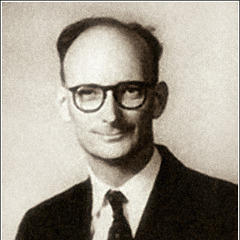
J. L. Austin
J. L. Austin

J. L. Austin (John Langshaw Austin, March 26, 1911 – February 8, 1960) was a prominent British philosopher and a leading figure in ordinary language philosophy. He studied and taught at Oxford University, where he developed his influential theory of speech acts, arguing that language is not merely descriptive but also performative. His seminal work, How to Do Things with Words, introduced the concepts of locutionary, illocutionary, and perlocutionary acts, and distinguished between performative and constative utterances. Austin's meticulous analysis of everyday language challenged traditional philosophical approaches and had a lasting impact on linguistics, philosophy of language, law, and literary theory. He died of lung cancer at age 48. more

You May Also Like

“Next, 'real' is what we may call a trouser-word. It is usually thought, and I dare say usually rightly thought, that what one might call the affirmative use of a term is basic--that, to understand 'x,' we need to know what it is to be x, or to be an x, and that knowing this apprises us of what it is not to be x, not to be an x. But with 'real' (as we briefly noted earlier) it is the negative use that wears the trousers.”

“Is it true or false that Belfast is north of London? That the galaxy is the shape of a fried egg? That Beethoven was a drunkard? That Wellington won the battle of Waterloo? There are various degrees and dimensions of success in making statements: the statements fit the facts always more or less loosely, in different ways on different occasions for different intents and purposes.”

“"What is truth?" said jesting Pilate, and would not stay for an answer. Pilate was in advance of his time. For "truth" itself is an abstract noun, a camel, that is, of a logical construction, which cannot get past the eye even of a grammarian. We approach it cap and categories in hand: we ask ourselves whether Truth is a substance (the Truth, the Body of Knowledge), or a quality (something like the colour red, inhering in truths), or a relation ("correspondence"). But philosophers should take something more nearly their own size to strain at. What needs discussing rather is the use, or certain uses, of the word "true." In vino, possibly, "veritas," but in a sober symposium "verum."”

“There is no one kind of thing that we 'perceive' but many different kinds, the number being reducible if at all by scientific investigation and not by philosophy: pens are in many ways though not in all ways unlike rainbows, which are in many ways though not in all ways unlike after-images, which in turn are in many ways but not in all ways unlike pictures on the cinema-screen--and so on.”

“The trouble is that the expression 'material thing' is functioning already, from the very beginning, simply as a foil for 'sense-datum'; it is not here given, and is never given, any other role to play, and apart from this consideration it would surely never have occurred to anybody to try to represent as some single kind of things the things which the ordinary man says that he 'perceives.”