Quotessence
Home / Quotes / Quote by Alexandre Dumas

Quote by Alexandre Dumas

Work

The Three Musketeers

Alexandre Dumas' 'The Three Musketeers' is a renowned historical novel that delves into the lives of d'Artagnan and his three fellow Musketeers, Athos, Porthos, and Aramis. The story is filled with intrigue, swordplay, and political machinations, set against the backdrop of the French monarchy. The novel is celebrated for its vivid characters, thrilling plot, and its exploration of themes such as loyalty, friendship, and honor. more
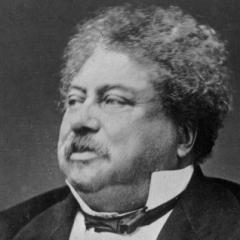
Author

Alexandre Dumas
Alexandre Dumas

Alexandre Dumas, a renowned French writer, was born on July 24, 1802, and died on December 5, 1870. He is famous for his historical and adventure novels, with notable works including 'The Three Musketeers' and 'The Count of Monte Cristo'. more

You May Also Like

“Nature programmed the neurobiological processes of early love to appear as something beyond the primitive sexual cravings of the genitals. So, from an evolutionary standpoint, it all leads to copulation and reproduction, but from the perspective of the individual who has recently fallen head over heels in love with someone, it is mostly about a sensation of warmth and delight, and rarely of sexual nature.”

“Love begins with the stage of subconscious primitive lust and attraction. I’m saying primitive because at this very early stage there is really no difference between primitive man and modern man.”

“All men either consciously or subconsciously crave for authority over their environment, especially over their peers in the society, male and female alike. Women on the other hand, crave for intimacy especially from their female peers in the society. Colloquially this is what you call “gossiping”.”

“People exercise the freedom to present themselves from a vast array of precepts. The modern human mind can engage in reflective thought and selectively determine how to organize the elements of perception. We can consciously elect to depart from stereotypical behavior and transcend the heretofore-established biological behavioral preferences. People can elect to hold prejudices or not, can make rational or irrational decisions to engage in war or not, and can take deliberate steps to arrest destruction of the ecosystem or not. Holding ourselves in check by placing a brake upon the human propensity to strike out in instinctual behavior is a distinct human quality. Restraint from instant gratification of strong impulses represents a unique human behavior trait. By intentionally refraining from committing an instinctual action, humankind asserts its sovereignty from its biological constitution. Unbound from the limitations of its biological nature, a person can employ the mind to devise alternative behavioral choices and the results of numerous behavioral choices culminate to provide a person with a sophisticated definition of the self.”