Quotessence
Home / Quotes / Quote by Juan Trippe

Quote by Juan Trippe

Author

Juan Trippe
Juan Trippe

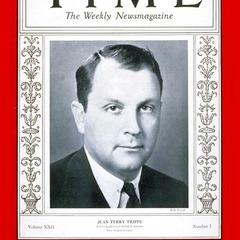
Juan Trippe was an American entrepreneur and a pioneer in the aviation industry. Born on June 27, 1899, and died on April 3, 1981, Trippe founded Pan American World Airways, which became one of the most successful international airlines in the 20th century. more

You May Also Like

“I wonder, only in passing, whether the indelible ornamentation that man inscribes upon his own epidermis does not respond to a nostalgia for the universal internally generated coloring of corrollas, furs, shells, carapaces and wings. For man it has been necessary to create both works and tools outside of himself. But it may be that he retains an obscure nostalgia to create them on his own body, to make them a part of it rather than projecting them outwards onto an independent surface, where he is free to retouch them as he sees fit, which is precisely what painting and art are.”

“Life appears: a complex dampness, destined to an intricate future and charged with secret virtues, capable of challenge and creation. A kind of precarious slime, of surface mildew, in which a ferment is already working. A turbulent, spasmodic sap, a presage and expectation of a new way of being, breaking with mineral perpetuity and boldly exchanging it for the doubtful privilege of being able to tremble, decay, and multiply.”

“I see the origin of the irresistible attraction of metaphor and analogy, the explanation of our strange and permanent need to find similarities in things. I can scarcely refrain from suspecting some ancient, diffused magnetism; a call from the center of things; a dim, almost lost memory, or perhaps a presentiment, pointless in so puny a being, of a universal syntax.”

“The seventeenth century is everywhere a time in which the state's power over everything individual increases, whether that power be in absolutist hands or may be considered the result of a contract, etc. People begin to dispute the sacred right of the individual ruler or authority without being aware that at the same time they are playing into the hands of a colossal state power.”

“The state incurs debts for politics, war, and other higher causes and 'progress'. . . . The assumption is that the future will honour this relationship in perpetuity. The state has learned from the merchants and industrialists how to exploit credit; it defies the nation ever to let it go into bankruptcy. Alongside all swindlers the state now stands there as swindler-in-chief.”