Quotessence
Home / Quotes / Quote by Seraphim of Sarov

Quote by Seraphim of Sarov

“...it is up to us to add labors to labors in order to go from strength to strength (Ps. 83:7), and to come to the measure of the stature of the fullness of Christ (Eph. 4:13)?”

Quote by Seraphim of Sarov

Author
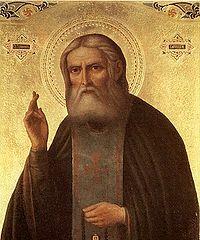
Seraphim of Sarov
Seraphim of Sarov

Seraphim of Sarov (August 1, 1754 – January 14, 1833) is one of the most venerated saints in the Russian Orthodox Church, renowned as a mystic and spiritual guide. Born in Kursk to a merchant family, he entered the Sarov Monastery at age 17. After years of extreme asceticism in the forest, including living alone in a hut and praying for a thousand nights on a rock, he became known for his humility and wisdom. In his later years, he received visitors, offering counsel on acquiring the Holy Spirit and inner peace. His teachings, especially the 'Acquisition of the Holy Spirit,' have deeply influenced Orthodox spirituality. He was canonized in 1903, and his relics are enshrined at the Sarov Monastery. more

You May Also Like

“The Lord came to send fire upon the earth (cf. Lk. 12:49), and through participation in this fire He makes divine not just the human substance which He assumed for our sake, but every person who is found worthy of communion with Him.”

“Do not desert a friend in time of need, nor forsake him nor fail him, for friendship is the support of life. Let us then bear our burdens as the Apostle has taught (cf. Gal. 6:2): for he spoke to those whom the charity of the same one body had embraced together. If friends in prosperity help friends, why do they not also in times of adversity offer their support? Let us aid by giving counsel, let us offer our best endeavors, let us sympathize with them with all our heart.”

“... at the beginning of the human race the woman was made of a rib taken from the side of the man while he slept; for it seemed fit that even then Christ and His Church should be foreshadowed in this event. For that sleep of the man was the death of Christ, whose side, as He hung lifeless upon the Cross, was pierced with a spear, and there flowed from it blood and water, and these we know to be the sacraments by which the Church is built up.”

“... when death has been brought upon a saint, we ought not to think that an evil has happened to him but a thing indifferent; which is an evil to a wicked man, while to the good it is rest and freedom from evils. 'For death is rest to a man whose way is hidden' (Job 3:23 LXX). And so a good man does not suffer any loss from it.”

“When you see your body wasted away through sickness, do not murmur against God, but say: 'The Lord gave, and the Lord has taken away; blessed be the name of the Lord' (Job 1:21). You are accustomed to look upon your body as upon your own inalienable property, but that is quite wrong, because your body is God's edifice.”

“Our Lord humbled without humiliation His lofty station which yet could not be humbled, and condescends to His servants, with a condescension ineffable and incomprehensible. God being perfect becomes perfect man, and brings to perfection the newest of all new things (cf. Eccles 1:10), the only new thing under the sun, through which the boundless might of God is manifested. For what greater thing is there than that God should become man?”

“... do not listen to vain and empty talk, in which the majority of world-loving people spend their time, and do not take pleasure in it. For the law says: 'You shall not raise false reports' (Ex. 23:1). Solomon says: 'Remove far from me vanity and lies' (Prov. 30:8). The Lord said: 'But I say to you, every idle word that men shall speak they shall give account thereof in the day of judgment' (Mt. 12:36).”

“... a Christian is quite certain to fall into the same sins which he condemns in another with merciless and inhuman severity, for 'a stern king will fall into misfortunes,' and 'one who stops his ears so as not to hear the weak, shall himself cry, and there shall be none to hear him' (Prov. 13:17; 21:13).”

“Let none of you have a soul which is barren and without fruit. Let nobody be unloving or unreceptive to the spiritual seed. May each of you eagerly accept the celestial seed, the word of salvation (cf. Lk. 8:11), and by your own efforts bring it to perfection as a heavenly work and fruit pleasing to God. Let no one make a beginning of a good work which brings no fruit to perfection (cf. Lk. 8:14), nor declare his faith in Christ only with His tongue.”