Quotessence
Home / Quotes / Quote by Paul Tillich

Quote by Paul Tillich

“The existential attitude is one of involvement in contrast to a merely theoretical or detached attitude. "Existential" in this sense can be defined as participating in a situation, especially a cognitive situation, with the whole of one's existence.”

Quote by Paul Tillich

Work

Writings on religion

This book delves into the intricacies of religious thought, examining different faiths and their underlying principles. It includes discussions on theological concepts, spiritual practices, and the impact of religion on society. more

Author

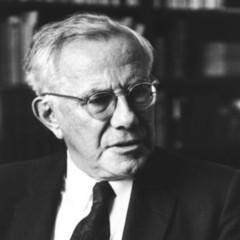
Paul Tillich
Paul Tillich

Paul Tillich (August 20, 1886 - October 22, 1965) was a German-American philosopher and theologian known for his profound contributions to religious philosophy, particularly on the concept of religious existence. His ideas have had a significant impact on 20th-century religious philosophy, theology, and theological ethics. more

You May Also Like

“One of the unfortunate consequences of the intellectualization of man's spiritual life was that the word "spirit" was lost and replaced by mind or intellect, and that the element of vitality which is present in "spirit" was separated and interpreted as an independent biological force. Man was divided into a bloodless intellect and a meaningless vitality. The middle ground between them, the spiritual soul, in which vitality and intentionality are united, was dropped.”

“[American] conformism might approximate collectivism, not so much in economic respects, and not too much in political respects, but very much in the pattern of daily life and thought. Whether this will happen or not, and if it does to what degree, is partly dependent on the power of resistance in those who represent the opposite pole of the courage to be, the courage to be as oneself.”

“The courage to be as oneself within the atmosphere of Enlightenment is the courage to affirm oneself as a bridge from a lower to a higher state of rationality. It is obvious that this kind of courage to be must become conformist the moment its revolutionary attack on that which contradicts reason has ceased, namely in the victorious bourgeoisie.”

“In a man like Friedrich von Schlegel the courage to be as an individual self produced complete neglect of participation, but it also produced, in reaction to the emptiness of this self-affirmation, the desire to return to a collective. Schlegel, and with him many extreme individualists in the last hundred years, became Roman Catholics. The courage to be as oneself broke down, and one turned to an institutional embodiment of the courage to be as a part.”