Quotessence
Home / Quotes / Quote by Nhat Hanh

Quote by Nhat Hanh

“It is possible that the next Buddha will not take the form of an individual. The next Buddha may take the form of a community -a community practicing understanding and loving kindness, a community practicing mindful living. This may be the most important thing we can do for the survival of the earth.”

Quote by Nhat Hanh

Author
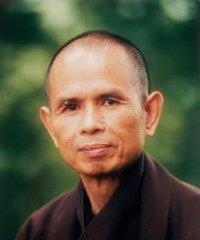
Nhat Hanh
Nhat Hanh

Thich Nhat Hanh is a Vietnamese-French monk, writer, and peace activist. Born on October 11, 1926, he is a prominent figure in the Zen Buddhist tradition, known for his simple yet profound teachings and advocacy for peace. more

You May Also Like

“God utters me like a word containing a partial thought of him. A word will never be able to comprehend the voice that utters it. But if I am true to the concept that God utters in me, if I am true to the thought of Him that I was meant to embody, I shall be full of his actuality and find him everywhere in myself, and find myself nowhere.”

“I strongly believe that nothing is more spiritual than living at our highest potential while serving others. I believe that the more closely aligned we are to "spirit" the more fully we will give ourselves in service to the world. As such, my "spiritual path" is the path that leads me to a more complete manifestation of my unique Bodhisattvic duties.”

“The Singularity denotes an event that will take place in the material world, the inevitable next step in the evolutionary process that started with biological evolution and has extended through human-directed technological evolution. however, it is precisely in the world of matter and energy that we encounter transcendence, a principal connotation of what people refer to as spirituality.”

“If the majority of the "spiritual market" is drawn to prerational magic and myth, how do you reach the small group who are involved in genuine, laborious, demanding, transrational spiritual practice? This is very difficult, because both markets are referred to as "spiritual," but these two camps really don't get along very well-one is mostly translative, the other is mostly transformative, and they generally disapprove of each other-so how do you put them into one magazine without alienating them both?”