Quotessence
Home / Quotes / Quote by Franz Kafka

Quote by Franz Kafka

“In general I lacked principally the ability to provide even in the slightest detail for the real future. I thought only of things in the present and their present condition, not because of thoroughness or any special, strong interest, but rather, to the extent that weakness in thinking was not the cause, because of sorrow and fear – sorrow, because the present was so sad for me that I thought I could not leave it before it resolved itself into happiness; fear, because, like my fear of the slightest action in the present, I also considered myself, in view of my contemptible, childish appearance, unworthy of forming a serious, responsible opinion of the great, manly future which usually seemed so impossible to me that every short step forward appeared to me to be counterfeit and the next step unattainable.”

Quote by Franz Kafka

Work

Diaries, 1910-1923

Browse quotes and source details for this work. more

Author
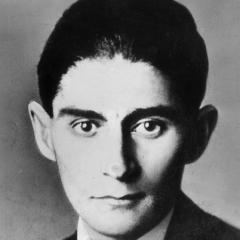
Franz Kafka
Franz Kafka

Franz Kafka (July 3, 1883 - June 3, 1924) was an important German-language novelist of the 20th century, known for his unique literary style and profound philosophical thoughts. His works, often themed around loneliness, alienation, and existentialism, have had a profound impact on literature and philosophy. more

You May Also Like

“The nature of a letter can also be revealed within its numeric value. All letters and numbers behave in a certain but recognizable way, from which we can deduce its nature. The number two is the only even prime. There is an inherent mathematical dilemma with, “one.” No matter how many times you multiply it, by itself, you still can’t get past “one” (1 x 1 x 1 x 1 = 1). So, how does “one” move beyond itself? How does the same, produce the different? Mathematically, “one” is forced to divide itself and work from that duality. Therein, hides the divine puzzle of bet (b). To become “two,” the second must revolt from wholeness—a separation. Yet, the second could not have existed without the benefit of the original wholeness. Also, the first wanted the second to exist, but the first doesn’t know what the second will become. Again, two contains potential badness, to a Hebrew. (Ge 25:24)”

“I was the builder of the prison; I was the one who locked the door. Now what should I have lost to free myself? Since I couldn't even feel my hunger, desperation, and desire, since I stopped dreaming, I lost the path of my destiny. Fumbled and tripped with every step because I became voiceless and stopped living.”

“It has always been difficult for Jews to take Christians serious, mostly because Christians lack the fundamentals that religious Jews learn in their youth. It remains an embarrassing fact, that modern Jews can comprehend the New Testament better than modern Christians. There is no excuse for this. Christians have dropped the ball and should be anxious to remedy that neglect. Not only would they benefit themselves, but their community too.”

“The Bible frequently uses symmetries and inversions. By such comparisons (parallels and contrasts) the unique aspects of reality begin to emerge. Comparing two objects makes their differences increasingly apparent. Only then can we ask, “Why does this one have that, and the other does not?” For instance: The phrase, “and it was 6 good” is present on all the days of creation—except the second day. Why? Because, “two” contains potential badness, to a Hebrew. We could not have discovered that insight, unless we contrasted God’s description of the creative days.”

“Scholars have argued that without humanism the Reformation could not have succeeded, and it is certainly difficult to imagine the Reformation occurring without the knowledge of languages, the critical handling of sources, the satirical attacks on clerics and scholastics, and the new national feeling that a generation of humanists provided. On the other hand, the long-term success of the humanists owed something to the Reformation. In Protestant schools and universities classical culture found a permanent home. The humanist curriculum, with its stress on languages and history, became a lasting model for the arts curriculum.”

“The common Calvinist experience of life as a refugee, or of being part of a host community that received refugees, led to lasting international connections between individuals and communities...As churches became established in Switzerland, the Palatinate, Scotland, England and Bearn, and the churches in the Netherlands, France, Hungary and Poland battled for legal recognition and survival, princely courts, noble houses, universities and colleges also became locations for interactions between many Calvinists. Theologians, clergy, students, booksellers, merchants, diplomats, courtiers and military officers became involved in networks of personal contacts, correspondence, teaching and negotiation.”