Quotessence
Home / Quotes / Quote by Kurt Vonnegut

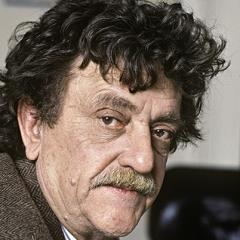
Quote by Kurt Vonnegut

“And evolution or God or whatever arranged things genetically, to keep the little families going, to cheer them up, so that they could all have somebody to tell stories around the campfire at night, and somebody else to paint pictures on the walls of caves, and somebody else who wasn't afraid of anything and so on.”

Quote by Kurt Vonnegut

Work

Bluebeard

This enduring story explores themes of jealousy, betrayal, and the dark side of human nature. The tale is often interpreted as a cautionary tale about the dangers of secrecy and the consequences of forbidden desires. more

Author

Kurt Vonnegut
Kurt Vonnegut

Kurt Vonnegut was an American writer known for his unique humor and profound satire. His works often explore themes of war, humanity, society, and politics. His most famous works include 'Slaughterhouse-Five' and 'Cat's Cradle'. His writing style has been widely appreciated by readers and has had a profound impact on literature. more

You May Also Like

“The arrival in Paris, as grim as ever. The leprous façades of the Pont Cardinet flats, behind which one invariably imagines retired folk agonizing alongside their cat Poucette which is eating up half their pension with its Friskies. Those weird metal structures that indecently mount each other to form a grid of overhead wires. And the inevitable advertising hoardings flashing by, gaudy and repellent. ‘A gay and changing spectacle on the walls.’ Bullshit. Pure fucking bullshit.”

“Treating Abuse Today 3(4) pp. 26-33 Freyd: The term "multiple personality" itself assumes that there is "single personality" and there is evidence that no one ever displays a single personality. TAT: The issue here is the extent of dissociation and amnesia and the extent to which these fragmentary aspects of personality can take executive control and control function. Sure, you and I have different parts to our mind, there's no doubt about that, but I don't lose time to mine they can't come out in the middle of a lecture and start acting 7 years old. I'm very much in the camp that says that we all are multi-minds, but the difference between you and me and a multiple is pretty tangible. Freyd: Those are clearly interesting questions, but that area and the clinical aspects of dissociation and multiple personalities is beyond anything the Foundation is actively... TAT: That's a real problem. Let me tell you why that's a problem. Many of the people that have been alleged to have "false memory syndrome" have diagnosed dissociative disorders. It seems to me the fact that you don't talk about dissociative disorders is a little dishonest, since many people whose lives have been impacted by this movement are MPD or have a dissociative disorder. To say, "Well, we ONLY know about repression but not about dissociation or multiple personalities" seems irresponsible. Freyd: Be that as it may, some of the scientific issues with memory are clear. So if we can just stick with some things for a moment; one is that memories are reconstructed and reinterpreted no matter how long ago or recent. TAT: You weigh the recollected testimony of an alleged perpetrator more than the alleged victim's. You're saying, basically, if the parents deny it, that's another notch for disbelief. Freyd: If it's denied, certainly one would want to check things. It would have to be one of many factors that are weighed -- and that's the problem with these issues -- they are not black and white, they're very complicated issues.”

“Type II trauma also often occurs within a closed context - such as a family, a religious group, a workplace, a chain of command, or a battle group - usually perpetrated by someone related or known to the victim. As such, it often involves fundamental betrayal of the relationship between the victim and the perpetrator and within the community (Freyd, 1994). It may also involve the betrayal of a particular role and the responsibility associated with the relationship (i.e., parent-child, family member-child, therapist-client, teacher-student, clergy-child/adult congregant, supervisor-employee, military officer-enlisted man or woman). Relational dynamics of this sort have the effect of further complicating the victim's survival adaptations, especially when a superficially caring, loving or seductive relationship is cultivated with the victim (e.g., by an adult mentor such as a priest, coach, or teacher; by an adult who offers a child special favors for compliance; by a superior who acts as a protector or who can offer special favors and career advancement). In a process labelled "selection and grooming", potential abusers seek out as potential victims those who appear insecure, are needy and without resources, and are isolated from others or are obviously neglected by caregivers or those who are in crisis or distress for which they are seeking assistance. This status is then used against the victim to seduce, coerce, and exploit. Such a scenario can lead to trauma bonding between victim and perpetrator (i.e., the development of an attachment bond based on the traumatic relationship and the physical and social contact), creating additional distress and confusion for the victim who takes on the responsibility and guilt for what transpired, often with the encouragement or insinuation of the perpetrator(s) to do so.”