Quotessence
Home / Quotes / Quote by Erich Fromm

Quote by Erich Fromm

“The courage of the authoritarian character is essentially a courage to suffer what fate or its personal representative or “leader” may have destined him for. To suffer without complaining is his highest virtue—not the courage of trying to end suffering or at least to diminish it. Not to change fate, but to submit to it, is the heroism of the authoritarian character.”

Quote by Erich Fromm

Work

Escape from Freedom

This book explores the complexities of human psychology, delving into the nature of freedom and its impact on individuals. It examines the various aspects of human behavior and the quest for autonomy, offering insights into the human experience. more

Author

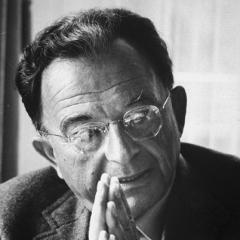
Erich Fromm
Erich Fromm

Erich Fromm, born on March 23, 1900 in Germany and died on March 18, 1980, was a renowned psychologist. His research covered a wide range of fields including anthropology, philosophy, and religion, particularly known for his studies on human psychology and interpersonal relationships. more

You May Also Like

“The duration of a person’s life is only a moment; our substance is flowing away this very moment; the senses are dim; the composition of the body is decaying, the soul is chaos, our fate is unknowable, and reputation uncertain. In a word all bodily things are like a flowing river, and everything of the soul is dream and smoke, and life is all warfare and a stranger’s wanderings, and the reward is oblivion. What then could possibly guide us? Only one thing: Philosophy.”

“All at once the anger ran out of John Harkless; he was a hard man for anger to tarry with. And in place of it a strong sense of home-coming began to take possession of him. He was going home. “Back to Plattville, where I belong,” he had said; and he said it again without bitterness, for it was the truth. “Every man cometh to his own place in the end.” Yes, as one leaves a gay acquaintance of the playhouse lobby for some hard-handed, tried old friend, so he would wave the outer world God-speed and come back to the old ways of Carlow. What though the years were dusty, he had his friends and his memories and his old black brier pipe. He had a girl’s picture that he should carry in his heart till his last day; and if his life was sadder, it was infinitely richer for it. His winter fireside should be not so lonely for her sake; and losing her, he lost not everything, for he had the rare blessing of having known her. And what man could wish to be healed of such a hurt? Far better to have had it than to trot a smug pace unscathed. He had been a dullard; he had lain prostrate in the wretchedness of his loss. “A girl you could put in your hat — and there you have a strong man prone.” He had been a sluggard, weary of himself, unfit to fight, a failure in life and a failure in love. That was ended; he was tired of failing, and it was time to succeed for a while. To accept the worst that Fate can deal, and to wring courage from it instead of despair, that is success; and it was the success that he would have. He would take Fate by the neck. But had it done him unkindness? He looked out over the beautiful, “monotonous” landscape, and he answered heartily, “No!” There was ignorance in man, but no unkindness; were man utterly wise he were utterly kind.”

“Lying in me, as though it were a white Stone in the depths of a well, is one Memory that I cannot, will not, fight: It is happiness, and it is pain. Anyone looking straight into my eyes Could not help seeing it, and could not fail To become thoughtful, more sad and quiet Than if he were listening to some tragic tale. I know the gods changed people into things, Leaving their consciousness alive and free. To keep alive the wonder of suffering, You have been metamorphosed into me.”

“Then spoke Gangleri: 'If norns determine the fates of men, they allot terribly unfairly, when some have a good and prosperous life, and some have little success or glory, some a long life, some short.' High said: 'Good norns, ones of noble parentage, shape good lives, but as for those people that become the victims of misfortune, it is evil norns that are responsible.”

“Hardest created thing is the Stone. Iron is even harder than Stone since it cuts the Stone. Fire is even harder than Iron since it can melt the Iron. Water is even harder than Fire since it can extinguish it. Clouds are even harder than Water since they move it around. Winds are even harder than Clouds since they move the Clouds around. Yet Angel who dispatches the Wind is harder than the Wind itself. And the Angel of Death is even harder than the Angel which dispatches the Winds since it can take away its life. And Death is even harder than the Angel of Death, since it takes away the Angel of Death. Yet harder than all these is the order of God - the Lord of the Two Worlds - which can take away death itself.”