“Science is the one human activity that is truly progressive. The body of positive knowledge is transmitted from generation to generation.”
Quote by Edwin Powell Hubble
Work
Hubble's Cosmology: A Guided Study of Selected Texts
This book provides an in-depth exploration of Edwin Hubble's contributions to cosmology, including a detailed examination of selected texts that discuss his theories and observations. It serves as a valuable resource for students and scholars interested in the history and development of cosmological thought. more
Author
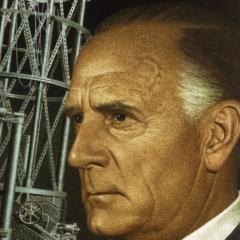
Edwin Powell Hubble
Edwin Powell Hubble was an American astronomer known for his significant contributions to observational cosmology and extragalactic astronomy. His discovery in 1929 that the universe is expanding was a major breakthrough, leading to the acceptance of the Big Bang theory. Hubble's work also provided evidence for the existence of galaxies beyond the Milky Way and helped establish Hubble's Law. more
You May Also Like
“Science is what we know, and philosophy is what we don't know.”
Source: Last Philosophical Testament: 1943-68
Source: The Mysterious Universe [New Revised Edition]
Source: Opera philosophica quae latine scripsit omnia: in unum corpusnunc primum collecta studio et labore Gulielmi Molesworth
“Scientific knowledge advances haltingly and is stimulated by contention and doubt.”
Source: Elements of Natural Philosophy
“Something unknown is doing we don't know what-that is what our theory amounts to.”
Source: The nature of the physical world