Quotessence
Home / Quotes / Quote by Fernando Henrique Cardoso

Quote by Fernando Henrique Cardoso

Author
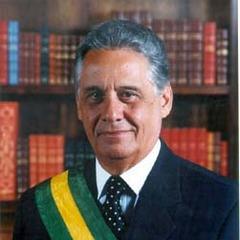
Fernando Henrique Cardoso

Former President of Brazil, a politician, and an economist. Born on June 18, 1931, Fernando Henrique Cardoso served as the President of Brazil from 1995 to 2003. During his presidency, he implemented significant economic reforms and focused on reducing poverty and improving education. more

You May Also Like

“One function of the librarian, as he saw it, was to blunt the edge of these differences and to provide a means whereby the rich and poor could live happily side by side. The public library was a great leveler, supplying a literature by which the ordinary man could experience some of the pleasures of the rich, and providing a common ground where employer and employee could meet on equal terms.”

“Contemporary political theorists continue this type of thinking about democracy by arguing that the development of "public judgment" among regular citizens should be made the central concern of modern politics. Public judgment, in the words of Benjamin Barber, is a function of commonality that can be exercised only by citizens interacting with one another in the context of mutual deliberation and decision.”

“A democratic public forms when citizens gather together to deliberate and make public judgments about local and national issues that affect their lives. By associating together for public discussion, citizens learn the skills necessary for the health of a democratic public; listening persuading, arguing, compromising, and seeking common ground. When these skills are nurtured within the institutions of a democratic public, citizens educate themselves in order to make informed political decisions.”

“From these activists we can learn a crucial lesson: without citizens creating the institutions necessary for facilitating the growth of public deliberation, democracy will be a meaningless term. Without political leaders articulating this idea and acting upon it, public life and citizenship will continue to stagnate.”

“At the 1894 ALA conference it was fairly well agreed that the primary goal of the public library must be to teach good citizenship. Libraries recognized that such "Americanization" could be achieved through literacy. Thus, teaching immigrants to read was not just a benefit in and of itself; literacy would also serve the interests of democracy.”

“Alliances are crucial to success in the political sphere. However, if we are to approach other organizations to propose alliances for the public good, we must be prepared to assert a far more important role for the library. We must clearly define what we do and establish and assert the relationship of libraries to basic democratic freedoms, to the fundamental humanistic principles that are central to our very way of life. . . .”

“When the function of libraries is put in terms of their contributions to the community, people see their centrality. The challenge to us is to continue to help them see it in those terms to describe our larger purposes. We must assert that libraries are central to the quality of life in our society; that libraries have a direct role in preserving democratic freedoms. Free access to information and the opportunity of every individual to improve his or her mind, employment prospects, and lifestyle are fundamental rights in our society.”

“One of my greatest sources of pride as president of the New York Public Library is the continuance of the library's open, free, and democratic posture, the fact that we are here for Everyman, that we are indeed Everyman's university, the place where the scholar who is not college-affiliated can come and work and feel at home.”