Quotessence
Home / Quotes / Quote by Claude Bernard

Quote by Claude Bernard

Work

An Introduction to the Study of Experimental Medicine

This book serves as a comprehensive guide to the field of experimental medicine, covering the historical context, fundamental concepts, and various experimental techniques. It explores the role of experimentation in advancing medical knowledge and the ethical considerations involved in conducting research on human subjects. more

Author
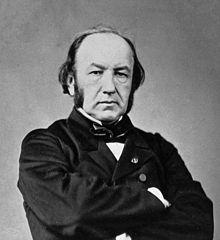
Claude Bernard
Claude Bernard

Claude Bernard was a French physiologist born on July 12, 1813, and died on February 10, 1878. He made significant contributions to the field of physiology, particularly in the study of the digestive system and the nervous system. more

You May Also Like

“It seems sensible to discard all hope of observing hitherto unobservable quantities, such as the position and period of the electron... Instead it seems more reasonable to try to establish a theoretical quantum mechanics, analogous to classical mechanics, but in which only relations between observable quantities occur.”

“Let people who have to observe sickness and death look back and try to register in their observation the appearances which have preceded relapse, attack or death, and not assert that there were none, or that there were not the right ones. A want of the habit of observing conditions and an inveterate habit of taking averages are each of them often equally misleading.”

“Magnitude may be compared to the power output in kilowatts of a [radio] broadcasting station; local intensity, on the Mercalli or similar scale, is then comparable to the signal strength noted on a receiver at a given locality. Intensity, like signal strength, will generally fall off with distance from the source; it will also depend on local conditions at the point of observation, and to some extent on the conditions along the path from source to that point.”

“Man does not limit himself to seeing; he thinks and insists on learning the meaning of phenomena whose existence has been revealed to him by observation. So he reasons, compares facts, puts questions to them, and by the answers which he extracts, tests one by another. This sort of control, by means of reasoning and facts, is what constitutes experiment, properly speaking; and it is the only process that we have for teaching ourselves about the nature of things outside us.”