Quotessence
Home / Quotes / Quote by Martin Rees

Quote by Martin Rees

“Most educated people are aware that we are the outcome of nearly 4 billion years of Darwinian selection, but many tend to think that humans are somehow the culmination. Our sun, however, is less than halfway through its lifespan. It will not be humans who watch the sun’s demise, 6 billion years from now. Any creatures that then exist will be as different from us as we are from bacteria or amoebae.”

Quote by Martin Rees

Author
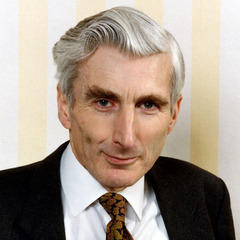
Martin Rees
Martin Rees

Martin Rees is a renowned British astronomer known for his research in cosmology. Born on June 23, 1942, he is a professor of astronomy at the University of Cambridge and has served as the President of the Royal Society. Rees' research focuses on the large-scale structure and evolution of the universe, particularly in the study of dark matter and dark energy. more

You May Also Like

“No physiologist who calmly considers the question in connection with the general truths of his science, can long resist the conviction that different parts of the cerebrum subserve different kinds of mental action. Localization of function is the law of all organization whatever: separateness of duty is universally accompanied with separateness of structure: and it would be marvellous were an exception to exist in the cerebral hemispheres.”

“Of what use are the great number of petrifactions, of different species, shape and form which are dug up by naturalists? Perhaps the collection of such specimens is sheer vanity and inquisitiveness. I do not presume to say; but we find in our mountains the rarest animals, shells, mussels, and corals embalmed in stone, as it were, living specimens of which are now being sought in vain throughout Europe. These stones alone whisper in the midst of general silence.”

“One should not understand this compulsion to construct concepts, species, forms, purposes, laws ('a world of identical cases') as if they enabled us to fix the real world; but as a compulsion to arrange a world for ourselves in which our existence is made possible:-we thereby create a world which is calculable, simplified, comprehensible, etc., for us.”

“Placed as the fossils are in their several tiers of burial-places the one over the other; we have in them true witnesses of successive existences, whilst the historian of man is constantly at fault as to dates and even the sequence of events, to say nothing of the contradicting statements which he is forced to reconcile.”

“Science is rooted in the will to truth. With the will to truth it stands or falls. Lower the standard even slightly and science becomes diseased at the core. Not only science, but man. The will to truth, pure and unadulterated, is among the essential conditions of his existence; if the standard is compromised he easily becomes a kind of tragic caricature of himself.”