Quotessence
Home / Quotes / Quote by Robert Browning

Quote by Robert Browning

Work

The Agamemnon of Aeschylus, La Saisiaz, Etc.

This book is a compilation of classical Greek dramatic works, featuring the renowned tragedy 'The Agamemnon' by Aeschylus, alongside other plays and literary pieces from the same era. more

Author
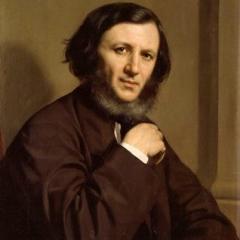
Robert Browning
Robert Browning

Robert Browning was a prominent Victorian poet known for his intricate poetic structures and profound psychological insights. His works covered themes such as love, death, religion, and morality, and had a profound impact on later poets. more

You May Also Like

“One and all We lend an ear-nay, Science takes thereto- Encourages the meanest who has racked Nature until he gains from her some fact, To state what truth is from his point of view, Mere pin-point though it be: since many such Conduce to make a whole, she bids our friend Come forward unabashed and haply lend His little life-experience to our much Of modern knowledge.”

“One hardly knows where, in the history of science, to look for an important movement that had its effective start in so pure and simple an accident as that which led to the building of the great Washington telescope, and went on to the discovery of the satellites of Mars.”

“One of the great problems of philosophy, is the relationship between the realm of knowledge and the realm of values. Knowledge is what is; values are what ought to be. I would say that all traditional philosophies up to and including Marxism have tried to derive the "ought" from the "is." My point of view is that this is impossible, this is a farce.”

“Only to often on meeting scientific men, even those of genuine distiction, one finds that they are dull fellows and very stupid. They know one thing to excess; they know nothing else. Pursuing facts too doggedly and unimaginatively, they miss all the charming things that are not facts. ... Too much learning, like too little learning, is an unpleasant and dangerous thing.”

“Our immediate interests are after all of but small moment. It is what we do for the future, what we add to the sum of man's knowledge, that counts most. As someone has said, 'The individual withers and the world is more and more.' Man dies at 70, 80, or 90, or at some earlier age, but through his power of physical reproduction, and with the means that he has to transmit the results of effort to those who come after him, he may be said to be immortal.”

“Our knowledge springs from two fundamental sources of the mind; the first is the capacity of receiving representations (receptivity for impressions), the second is the power of knowing an object through these representations (spontaneity [in the production] of concepts).”

“Remember that accumulated knowledge, like accumulated capital, increases at compound interest: but it differs from the accumulation of capital in this; that the increase of knowledge produces a more rapid rate of progress, whilst the accumulation of capital leads to a lower rate of interest. Capital thus checks it own accumulation: knowledge thus accelerates its own advance. Each generation, therefore, to deserve comparison with its predecessor, is bound to add much more largely to the common stock than that which it immediately succeeds.”