Quotessence
Home / Quotes / Quote by Willis R. Whitney

Quote by Willis R. Whitney

“Our immediate interests are after all of but small moment. It is what we do for the future, what we add to the sum of man's knowledge, that counts most. As someone has said, 'The individual withers and the world is more and more.' Man dies at 70, 80, or 90, or at some earlier age, but through his power of physical reproduction, and with the means that he has to transmit the results of effort to those who come after him, he may be said to be immortal.”

Quote by Willis R. Whitney

Author
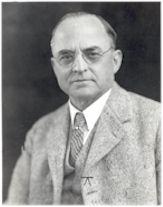
Willis R. Whitney
Willis R. Whitney

Willis R. Whitney was an outstanding chemist known for his contributions to the field of organic chemistry. He was born on August 11, 1868, and passed away on January 9, 1958. Whitney played a significant role in the development of the chemical industry, particularly in the synthesis of dyes and drugs. more

You May Also Like

“Our knowledge springs from two fundamental sources of the mind; the first is the capacity of receiving representations (receptivity for impressions), the second is the power of knowing an object through these representations (spontaneity [in the production] of concepts).”

“Remember that accumulated knowledge, like accumulated capital, increases at compound interest: but it differs from the accumulation of capital in this; that the increase of knowledge produces a more rapid rate of progress, whilst the accumulation of capital leads to a lower rate of interest. Capital thus checks it own accumulation: knowledge thus accelerates its own advance. Each generation, therefore, to deserve comparison with its predecessor, is bound to add much more largely to the common stock than that which it immediately succeeds.”

“Research is industrial prospecting. The oil prospectors use every scientific means to find new paying wells. Oil is found by each one of a number of methods. My own group of men are prospecting in a different field, using every possible scientific means. We believe there are still things left to be discovered. We have only stumbled upon a few barrels of physical laws from the great pool of knowledge. Some day we are going to hit a gusher.”

“Science has a simple faith, which transcends utility. Nearly all men of science, all men of learning for that matter, and men of simple ways too, have it in some form and in some degree. It is the faith that it is the privilege of man to learn to understand, and that this is his mission. If we abandon that mission under stress we shall abandon it forever, for stress will not cease. Knowledge for the sake of understanding, not merely to prevail, that is the essence of our being. None can define its limits, or set its ultimate boundaries.”