Quotessence
Home / Quotes / Quote by Gregory of Nyssa

Quote by Gregory of Nyssa

“But if one wishes to be absolute master of all, to obtain the entire inheritance, and to exclude his brothers from even a third or fifth part, he is not a brother, but a harsh tyrant, a rude savage, nay, more, an insatiable beast that would devour the whole sweet banquet with his own gaping mouth.”

Quote by Gregory of Nyssa

Author
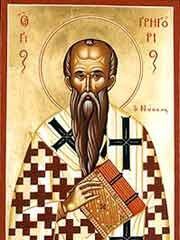
Gregory of Nyssa
Gregory of Nyssa

St. Gregory of Nyssa was a Christian theologian and philosopher from the 4th century, known for his significant contributions to the fields of Christian mysticism and cosmology. His writings have had a profound impact on Christian theology, particularly in the areas of mysticism and creation. more

You May Also Like

“Furthermore, consider that as one of its most important purposes, stewardship of creation should sustain nature's worshiping capacity. The more I reflect on Scriptures and the more I sense how God thrills to the adoration He receives from all that He has created, the more I realize He has given us the awesome responsibility of caring for His creation so that it can go on praising Him until the end of time.”

“God never gives dominion to any creature which has not received his image. His image is love. Other things belong to God; but God is love. No creature that has not love will be allowed to have a permanent empire. The Father of mercy will not put the reigns of government into a hand that has no heart. Dominion is a very solemn thing; it may oppress, crush, destroy. The Father must have a guarantee for its gentleness. What guarantee can there be but his image - the possession of a nature tender as the Divine?”

“I started by saying that one of the most fateful errors of our age is the belief that the problem of production has been solved. This illusion, I suggested, is mainly due to our inability to recognize that the modern industrial system, with all its intellectual sophistication, consumes the very basis on which is has been erected. To use the language of the economist, it lives on irreplaceable capital which it cheerfully treats as income.”

“If the flower were not attached to its stem, it would flee at the approach of man, like the insect or the bird; for the attribute of man on the earth, at least as long as he does not better understand his role, is to worry and frighten what he is not interested in taming for utilitarian purposes. Man is skillful in mistreating everything he can use”

“Judaism calls for us to honor the rhythm of human life, the demands of the human community around us, the call of the divine order as the filter and scale for the decisions that drive our own small lives. We do not rule the universe, Judaism reminds us. God does. We are not its standard or its norms. We are only its keepers, its agents, its stewards. To do right by the universe at large is the measure of a happiness framed with the entire cosmos in mind but lived in microcosms across time.”

“Now there are heavy houses everywhere and more of them are being built. In fact, it is only when more houses are being constructed that some countries consider their economics healthy. Yet each house is a heavy footprint on the Earth. Just as all our possessions represent-if we cannot learn ways of sharing them-a weight and clutter that often means the faces of future generations will look up into darkness and the pressure on the Earth of "things."”