“According to the technical language of old writers, a thing and its qualities are described as subject and attributes; and thus a man's faculties and acts are attributes of which he is the subject. The mind is the subject in which ideas inhere. Moreover, the man's faculties and acts are employed upon external objects; and from objects all his sensations arise. Hence the part of a man's knowledge which belongs to his own mind, is subjective: that which flows in upon him from the world external to him, is objective.”
Quote by William Whewell
Work
History of Scientific Ideas: Being the First Part of The Philosophy of the Inductive Sciences
In this scholarly work, the author delves into the historical development of scientific ideas, tracing the progression of inductive reasoning and its impact on various scientific disciplines. The text serves as an insightful examination of the philosophical underpinnings of scientific inquiry and the evolution of scientific knowledge over time. more
Author
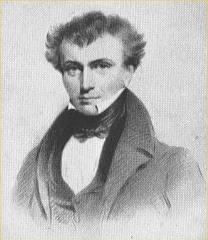
William Whewell
William Whewell was a polymath from England, born on May 24, 1794, and died on March 6, 1866. He made significant contributions to the fields of scientific philosophy, the history of science, logic, mathematics, and astronomy. more
You May Also Like
“He who binds His soul to knowledge, steals the key of heaven.”
Source: The poetical works of N.P. Willis
“A man who knows how little he knows is well, a man who knows how much he knows is sick.”
Source: The Middle Works, 1899-1924
“Whatever you might say the object "is", well it is not.”
Source: Science and Sanity: An Introduction to Non-Aristotelian Systems and General Semantics
Source: Autobiography
Source: History of Western Philosophy
Source: Mark Twain at Your Fingertips: A Book of Quotations
“A very great deal more truth can become known than can be proven.”
Source: The Quotable Feynman
“While knowledge is orderly and cumulative, information is random and miscellaneous.”