Quotessence
Home / Quotes / Quote by Ralph Waldo Emerson

Quote by Ralph Waldo Emerson

Work

Essays and Lectures

This book is a compilation of written works and spoken presentations that delve into a wide range of subjects, offering insights and perspectives on different themes and concepts. more
Author

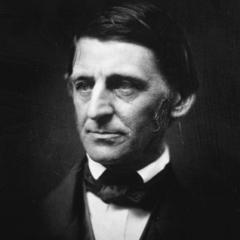
Ralph Waldo Emerson
Ralph Waldo Emerson

American essayist, poet, and philosopher. Born on May 25, 1803, and died on April 27, 1882. Known for his transcendentalist philosophy, his works have had a profound impact on literature and the intellectual world. more

You May Also Like

“All forms of beauty, like all possible phenomena, contain an element of the eternal and an element of the transitory - of the absolute and of the particular. Absolute and eternal beauty does not exist, or rather it is only an abstraction creamed from the general surface of different beauties. The particular element in each manifestation comes from the emotions: and just as we have our own particular emotions, so we have our own beauty.”

“As some tall cliff that lifts its awful form, Swells from the vale, and midway leaves the storm,- Though round its breast the rolling clouds are spread, Eternal sunshine settles on its head.”

“Comparatively, we are so much quicker to return favors and to pay our debts to mortals - and we should be responsive and grateful. But what of Him who gave us mortal life itself, who will ere long give us all immortality, and who proffers to the faithful the greatest gift of all, eternal life? We are poor bookkeepers, indeed!”

“All of us must walk the same strait and narrow path, know the same kind of experiences as those we would seek to lead and to serve. There is not one strait and narrow path for the officers-the chosen-and another for the enlisted men. We are all to experience life "according to the flesh"; there is no other way, for it is the way to immortality and eternal life. Given the resplendent riches of the promised kingdom, why would anyone wish to walk another path than the one that leads us back to our gracious and merciful Father in Heaven?”

“Nothing has afforded me so convincing a proof of the unity of the Deity as these purely mental conceptions of numerical and mathematical science which have been by slow degrees vouchsafed to man, and are still granted in these latter times by the Differential Calculus, now superseded by the Higher Algebra, all of which must have existed in that sublimely omniscient Mind from eternity.”