Quotessence
Home / Quotes / Quote by John F. Kennedy

Quote by John F. Kennedy

“Equality in America has never meant literal equality of condition or capacity. There will always be inequalities in character and ability in any society. Equality has meant rather that in the words of the Declaration of Independence, "All men are created equal and are endowed by their creator with certain unalienable rights." It is meant that in a democratic society there should be no inequalities in opportunities or in freedoms.”

Quote by John F. Kennedy

Work

A Nation Of Immigrants

This book delves into the historical and cultural impact of immigration on American society, exploring the contributions and experiences of diverse immigrant groups throughout history. more

Author
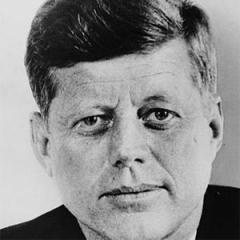
John F. Kennedy
John F. Kennedy

John F. Kennedy was the 35th President of the United States, serving from 1961 to 1963. His presidency was marked by the Civil Rights Act, the New Frontier policy, and the intense Cold War confrontation with the Soviet Union. Kennedy was known for his youthful charm and charisma, but his assassination during his term shocked the world. more

You May Also Like

“She was a little removed,” Jack said as an adult. In private, he complained that Rose never told him that she loved him. Jack’s friend Charles Spalding, who saw the family up close, described Rose as “so cold, so distant from the whole thing . . . I doubt if she ever rumpled the kid’s hair in his whole life. . . . It just didn’t exist: the business of letting your son know you’re close, that she’s there. She wasn’t.” Jacqueline Bouvier Kennedy told the journalist Theodore White that “history made him [Jack] what he was . . . this lonely sick boy. His mother really didn’t love him. . . . She likes to go around talking about being the daughter of the Mayor of Boston, or how she was an ambassador’s wife. . . . She didn’t love him. . . . History made him what he was.”

“By the time John F. Kennedy became involved in 1961, the situation was out of control. So Kennedy simply invaded the country. In 1962, he sent the U.S. Air Force to start bombing South Vietnam, using planes with South Vietnamese markings. Kennedy authorized the use of napalm, chemical warfare, to destroy the ground cover and crops. He started the process of driving the rural population into what were called 'strategic hamlets,' essentially concentration camps, where people were surrounded by barbed wire, supposedly to protect them from the guerillas who the U.S. government knew perfectly well they supported. This 'pacification' ultimately drove millions of people out of the countryside while destroying large parts of it. Kennedy also began operations against North Vietnam on a small scale. That was 1961.”

“By the time John F. Kennedy became involved in 1961, the situation was out of control. So Kennedy simply invaded the country. In 1962, he sent the U.S. Air Force to start bombing South Vietnam, using planes with South Vietnamese markings. Kennedy authorized the use of napalm, chemical warfare, to destroy the ground cover and crops. He started the process of driving the rural population into what were called 'strategic hamlets,' essentially concentration camps, where people were surrounded by barbed wire, supposedly to protect them from the guerillas who the U.S. government knew perfectly well they supported. This 'pacification' ultimately drove millions of people out of the countryside while destroying large parts of it. Kennedy also began operations against North Vietnam on a small scale. That was 1962.”

“In 1963, the Kennedy administration got wind of the fact that the government of Ngo Dinh Diem it had installed in South Vietnam was trying to arrange peace negotiations with the North. Diem and his brother, Ngo Dinh Nhu, were trying to negotiate a peace settlement. So the Kennedy liberals determined that they had to be thrown out. The Kennedy administration organized a coup in which the two brothers were killed and they put in their own guy, meanwhile escalating the war. Then came the assassination of President Kennedy. Contrary to a lot of mythology, Kennedy was one of the hawks in the administration to the very last minute. He did agree to proposals for withdrawal from Vietnam, because he knew the war was very unpopular there, but always with the condition of withdrawal after victory.”