Quotessence
Home / Quotes / Quote by A. E. Housman

Quote by A. E. Housman

Work

A Shropshire Lad

A Shropshire Lad is a volume of poetry that delves into the rustic charm and natural beauty of Shropshire, capturing the essence of rural life through a series of poignant and reflective verses. The poems explore themes of love, longing, and the passage of time, offering a vivid portrayal of the English countryside and its inhabitants. The work is known for its evocative imagery and emotional depth, showcasing the author's appreciation for the simplicity and beauty of rural existence. more
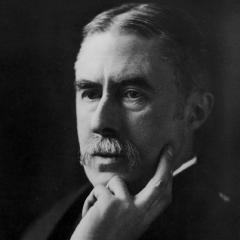
Author

A. E. Housman
A. E. Housman

A. E. Housman, born on March 26, 1859, was a renowned British poet known for his profound emotions and classical style. His works, such as 'A Shropshire Lad', are celebrated for their depth and classical references. Housman's poetry has had a lasting impact on 20th-century British literature and remains widely read and studied today. more

You May Also Like

“Had I not gone through the ordeal, in more than one country, of landing a job, I would he tempted to lose patience over the number of letters pouring in from fellows who want me or someone else to hand them a job on a silver platter with a guarantee that they will receive the wonderful promotion their talents warrant.... But a tragic number of young men and even older men have a notion that it is not up to them to prosecute the bettering process. They look to someone else to perform the trick for them.”

“Is America becoming decadent? Do we no longer regard our promises and pledges as sacred? ... We promised to make peace with Germany only in conjunction with the Allies; but we brought forward a separate peace, demanding for ourselves all the advantages of the Treaty of Versailles but rejecting all the responsibilities embodied in the Treaty. It was America's President who induced Europe to form a League of Nations; and then America was the first country that refused to joint it.... If these are not the symptoms of national decadency, what are they?”

“The British have their own conception of what constitutes the typical American. He must have a flavor of the Wild West about him. He must do spectacular things. He must not be punctilious about dignity, decorum and other refinements characteristic of the real British gentleman. The Yankee pictured by the Briton must be a bustler. If he is occasionally flagrantly indiscreet in speech and action, then he is so much more surely stamped the genuine article. The most typical American the British ever set their eyes on was, in their judgment, Theodore Roosevelt.”

“What would you call America's most priceless asset? Surely not its limitless natural resources, not its matchless national wealth, not its unequalled store of gold, not its giant factories, not its surpassing railroads, not its unprecedented volume of cheap power. Is not its most priceless asset the character of its people, their indomitable self-confidence, their transcendent vision, their sleepless initiative and, perhaps above all, their inherent, irrepressible optimism?”

“The man who is bigger than his job keeps cool. He does not lose his head, he refuses to become rattled, to fly off in a temper. The man who would control others must be able to control himself. There is something admirable, something inspiring, something soul-stirring about a man who displays coolness and courage under extremely trying circumstances. A good temper is not only a business asset. It is the secret of health. The longer you live, the more you will learn that a disordered temper breeds a disordered body.”

“Has your work become very easy? Do you find you can do it with little effort? Has it ceased to impose any strain or fatigue upon you? Do you no longer feel loss of vitality after a long spell of it? Can you now do it as easy as water rolls off a duck's back? If so, look out! Do some stock-taking. Examine your output.... Work done with little effort is likely to yield little result. Every job can be done excellently or indifferently. Excellence necessitates effort-hard, sustained, concentrated effort.”

“Ugliness, squalor are breeding grounds for revolution. Beauty is conducive to tranquillity, happiness. Beautifying of homes and places of worship began with the dawn of civilization. Beautifying of workplaces is only in its infancy. Yet, since men normally spend more than half of their waking hours at work, surely it is important that adequate attention be devoted to elevating their working environment, whether office or factory, foundry or machine shop, mine or warehouse. Beautiful surroundings subtly encourage beautiful living. Drab surroundings, bad air, bad light, evoke bad reactions.”