Quotessence
Home / Quotes / Quote by Black Elk

Quote by Black Elk

Work

Black Elk Speaks: Being the Life Story of a Holy Man of the Oglala Sioux

This book is a first-hand account of the author's spiritual awakening and his role as a medicine man within the Oglala Sioux tribe. It offers insights into the culture, traditions, and spiritual beliefs of the Oglala Sioux people. more

Author
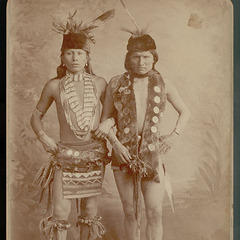
Black Elk
Black Elk

Black Elk, whose real name was Netsahihoka, was a medicine man of the Omaha Sioux tribe. Born on December 1, 1863, and died on August 19, 1950, Black Elk is known for his profound spiritual insight and contributions to the Sioux culture. more

You May Also Like

“All I try to do is portray Indians as we are, in creative ways. With imagination and poetry. I think a lot of Native American literature is stuck in one idea: sort of spiritual, environmentalist Indians. And I want to portray everyday lives. I think by doing that, by portraying the ordinary lives of Indians, perhaps people learn something new.”

“Humor is widely used by Indians to deal with life. Indian gatherings are marked by laughter and jokes, many directed at the horrors of history, at the continuing impact of colonization, and at the biting knowledge that living as an exile in one's own land necessitates. . . . Certainly the time frame we presently inhabit has much that is shabby and tricky to offer; and much that needs to be treated with laughter and ironic humor.”

“What we did in the 1960s and early 1970s was raise the consciousness of white America that this government has a responsibility to Indian people. That there are treaties; that textbooks in every school in America have a responsibility to tell the truth. An awareness reached across America that if Native American people had to resort to arms at Wounded Knee, there must really be something wrong. And Americans realized that native people are still here, that they have a moral standing, a legal standing. From that, our own people began to sense the pride.”

“Everything an Indian does is in a circle, and that is because the power of the world always works in circles, and everything tries to be round. In the old days when we were a strong and happy people, all our power came to us from the sacred hoop of the nation, and so long as the hoop was unbroken the people flourished.”

“I certainly don't object to [writers] trying to imagine the lives of other societies, but you have to do it with a certain amount of humility and respect. If it were not for the ethnographic material that had been collected by missionaries and anthropologists and so forth, much of past Native American society would no longer be accessible. What I object to is making kitsch of things that are very serious.”

“There aren't a lot of alternative roles for Indian actors. I think we've fallen short of portraying Indians in the media. We don't need to make another Dances With Wolves, because it's not an Indian movie. When Indians portray themselves, then we have a different perspective. I've been asked about making period pieces but I've never read one that wasn't about guilt, and I'm not trying to make a guilt film.”